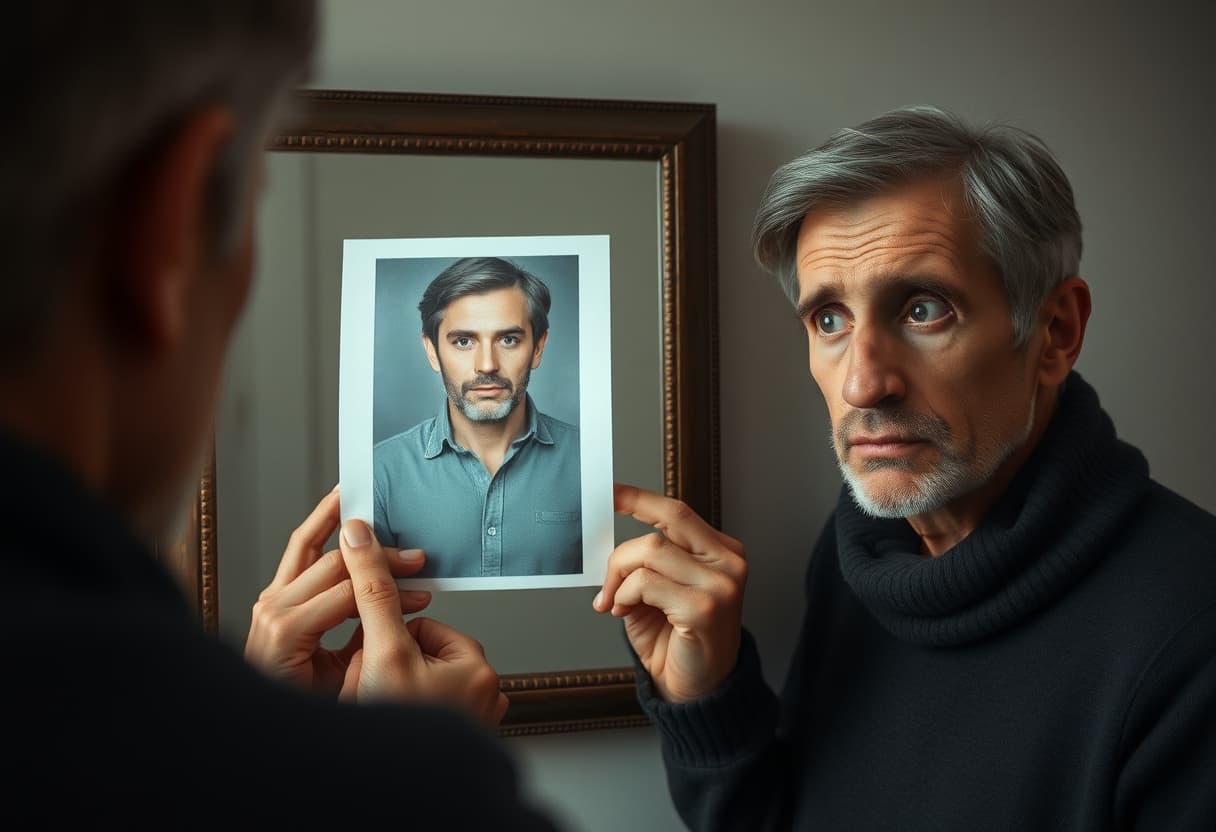
There is a question underneath most other philosophical questions, one that rarely gets asked directly: what does it mean for someone to persist through time? You wake up tomorrow — are you the same person who went to sleep? You look at a photograph from twenty years ago — is that you? The cells in your body have largely been replaced. Your beliefs, memories, and personality have changed. In what sense, if any, are you the same entity?
This is the problem of personal identity, and it is not merely academic. It touches on what we owe to our future selves, what we can be held accountable for from our past, what happens to "us" when we die, and whether the self is even a coherent thing to talk about at all.
Locke and the Memory Theory
The most influential early modern account came from John Locke in his Essay Concerning Human Understanding (1689). Locke argued that psychological continuity — specifically, memory — is what makes a person the same person over time.¹ You are the same person as the child in that old photograph if and only if you have (or could have) a chain of memories connecting you to that child's experiences.
This was a genuinely radical move. Before Locke, personal identity was usually grounded in the soul — the same immaterial substance persisting through time. Locke relocated identity from substance to consciousness. What matters isn't that the same stuff continues, but that the same psychological thread continues.
The memory theory has intuitive appeal. When we're drunk, sleepwalking, or severely dissociating, we feel less responsible for our actions partly because we don't remember them — they feel disconnected from the self we identify with. Courts take memory and mental state into account in assessing moral and legal responsibility. Locke was onto something real.
But the theory faces sharp objections. The most famous comes from Thomas Reid's brave officer paradox: imagine a general who remembers being flogged as a boy, but no longer remembers his first battle as a young officer. The young officer remembered the flogging. By Locke's logic, the general is the same person as the officer, and the officer is the same person as the boy — but the general is not the same person as the boy, since he doesn't remember the flogging. This violates transitivity, which any theory of identity must satisfy.²
Parfit and the Dissolution of the Self
The most radical contribution to this debate in the 20th century came from Derek Parfit's Reasons and Persons (1984). Parfit accepted something like the psychological continuity view but drew a startling conclusion from it: personal identity may not be what matters.³
Parfit used thought experiments involving fission — cases where a person's brain is split and transplanted into two bodies, each carrying an equal share of memories and personality. Which resulting person is "you"? Neither? Both? Either?
His conclusion was that these cases reveal something deep: identity is not a further fact beyond the physical and psychological facts. There is no deep truth about whether the person in scenario A is "really" you. What there is are degrees of psychological connectedness and continuity — and those degrees matter for things like responsibility, caring about the future, and survival. But they don't require a persisting self in any robust metaphysical sense.
We are not separately existing entities. We are not, in some deep further sense, the same person as our earlier selves. We are connected to them — and that connection matters — but it does not require a soul-like substance to hold it together. — Derek Parfit (paraphrased from Reasons and Persons)
Parfit found this liberating rather than terrifying. If the self is not what we thought, then the boundary between my welfare and yours is less sharp than it appears. His work has been influential in consequentialist ethics, particularly arguments for more concern about future generations and distant others.
Buddhist Resonances and Christian Tensions
Parfit himself noted that his conclusions resemble Buddhist anattā — the doctrine of no-self. Buddhist philosophy has long argued that the self is a construction, a useful fiction assembled from moment-to-moment experience rather than a persisting substance. Clinging to the illusion of a fixed self is, in Buddhist thought, one of the root causes of suffering.
The Christian tradition takes a different shape. The doctrines of resurrection, final judgment, and eternal life all presuppose that the person who is raised and judged is meaningfully the same person who lived. But Christian theology has not been univocal about what exactly makes that identity hold across death. Some traditions lean on the soul; others (notably certain Reformed views) are more comfortable with God's direct act of re-creation as sufficient to ground identity.
The tension with Parfit is real, but it may be less fatal to Christian commitments than it first appears. If what God raises is the psychological pattern — the person as remembered and known — rather than the exact physical or even immaterial substrate, Parfitian insights might be more compatible with resurrection than they seem.
Why Any of This Matters
The problem of personal identity isn't a puzzle for its own sake. It shapes how we think about:
- Moral responsibility: Can you be held responsible for something a very different version of yourself did decades ago?
- Future-self discounting: If your future self is a different person, is saving for retirement a form of charity to a stranger?
- End-of-life ethics: Does a person with severe dementia have the same interests as the person who wrote an advance directive years before?
- Criminal justice: What is the point of imprisoning a person who has genuinely changed since committing a crime?
These aren't abstract questions. They appear in courtrooms, medical ethics committees, and family conversations every day. And behind each of them is the same unresolved philosophical question: what makes a person the same person over time?
We are all, in a real sense, becoming different people. The question is what connects us to who we were — and whether that connection is enough to matter.
Sources ¹ John Locke — An Essay Concerning Human Understanding, Book II, Ch. 27 (1689) ² Thomas Reid — Essays on the Intellectual Powers of Man, Essay III, Ch. 6 (1786) ³ Derek Parfit — Reasons and Persons, Part III (Oxford University Press, 1984)