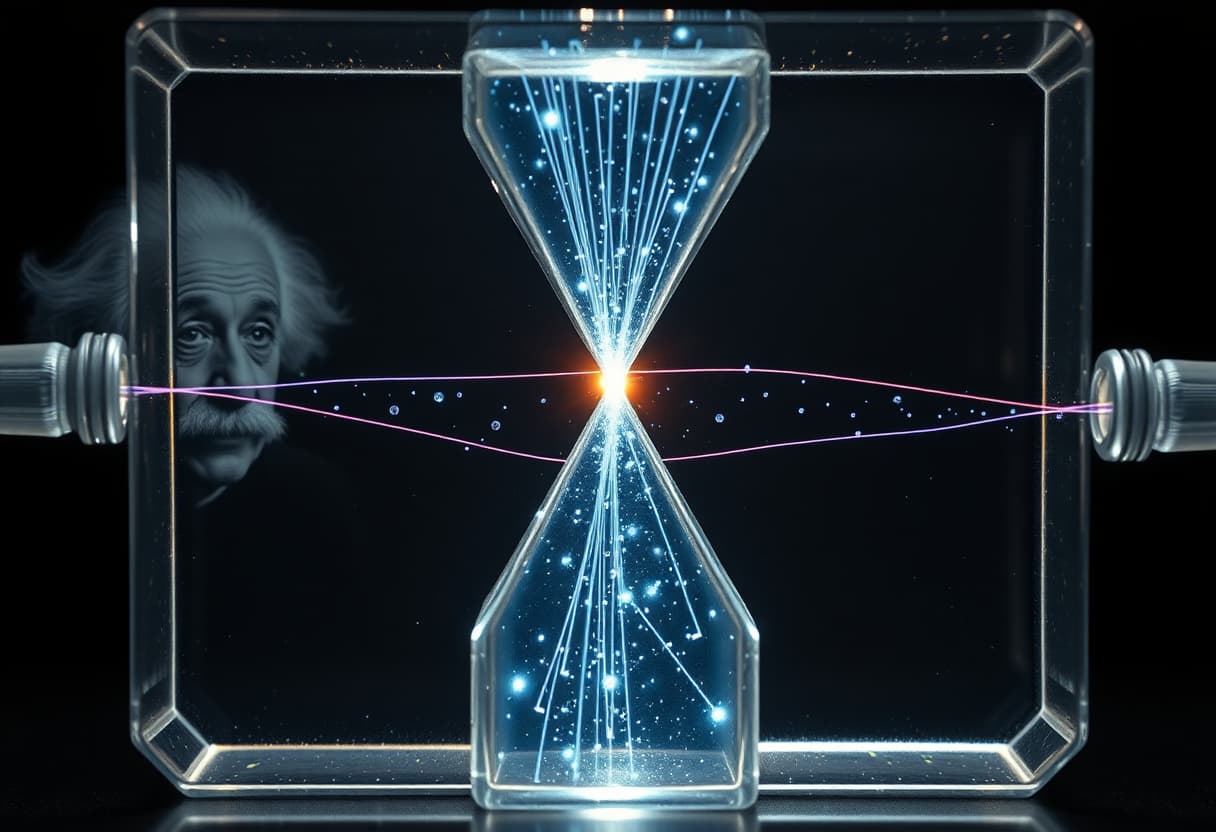
In the 1960s, a physicist named John Stewart Bell did something remarkable: he proved that a certain class of philosophical questions about quantum mechanics were not, in fact, merely philosophical. They were empirically testable. His result, known as Bell's theorem, transformed what had been a debate about interpretation into an experimental question — and the experiments have since returned answers that are genuinely strange.
Understanding what Bell proved, and what it means, requires backing up a little.
The Einstein-Bohr Debate
When quantum mechanics was being formalized in the 1920s and 30s, it came with a deeply unsettling feature: fundamental indeterminacy. In classical physics, if you knew the complete state of a system, you could in principle predict its future behavior with certainty. Quantum mechanics said this was impossible, even in principle. Particles do not have definite properties until they are measured. Before measurement, they exist in superpositions — combinations of possible states.
Albert Einstein found this intolerable. He could accept that our knowledge of a particle's state might be uncertain, but not that the particle itself lacked a definite state prior to measurement. He and colleagues Boris Podolsky and Nathan Rosen published a famous paper in 1935 arguing that quantum mechanics must be incomplete — that there must be "hidden variables," additional information that, if known, would restore determinism.¹
Niels Bohr disagreed. He argued that quantum mechanics was complete — that asking about the "real" state of a particle independent of measurement was simply meaningless.
For decades, this seemed like an irresolvable philosophical dispute. Then Bell found the lever that converted it into a physics question.
Bell's Theorem
Bell's 1964 paper showed that any local hidden variable theory — any theory in which particles have definite properties before measurement, and in which influences cannot travel faster than light — must satisfy certain mathematical inequalities.² If the inequalities were violated in experiments, local hidden variable theories were ruled out.
The key experiments were conducted by John Clauser in the early 1970s and then decisively by Alain Aspect and colleagues in 1982. They measured pairs of entangled particles — particles whose quantum states are correlated in such a way that measuring one instantly affects the probabilities for the other, regardless of the distance between them. The results consistently violated Bell's inequalities.³
In 2022, Aspect, Clauser, and Anton Zeilinger were awarded the Nobel Prize in Physics for this work.
The universe, at its most fundamental level, is not locally realistic in the way our intuitions demand.
What Entanglement Is — and Isn't
Quantum entanglement is the phenomenon at the heart of Bell's experiments. When two particles become entangled — through a shared origin or interaction — their quantum states are correlated. Measuring the spin of one particle instantly constrains what you'll find when you measure the other, even if the two particles are on opposite sides of the galaxy.
This sounds like faster-than-light communication, but it isn't — and understanding why requires care. The correlation is real, but neither particle has a definite spin value before measurement. When you measure particle A, you get a random result. The correlation only becomes apparent when you compare results with someone who measured particle B. That comparison requires classical communication, which is limited to light speed. So no information travels faster than light.
What is strange is not the transmission of a signal but the nature of the correlation itself. The particles seem to "know" about each other's measurement outcomes instantaneously, in a way that cannot be explained by any prior shared information they carried.
The Remaining Interpretive Questions
Bell's theorem rules out local hidden variable theories. But it does not settle which interpretation of quantum mechanics is correct — only which ones are impossible. Several interpretations remain viable:
Copenhagen interpretation: The original formulation — wave function collapse occurs upon measurement, and asking about the state of a particle prior to measurement is not a meaningful question.
Many-worlds interpretation: Every measurement causes the universe to branch; all possible outcomes occur in different branches. No randomness, no collapse — just ever-proliferating parallel histories.
Pilot wave theory (Bohmian mechanics): A non-local hidden variable theory in which particles have definite positions, guided by a real wave. It reproduces all quantum predictions but requires instantaneous influences across space — non-local, but consistent with Bell because Bell only rules out local hidden variables.
Each interpretation is mathematically consistent with the experimental results. The disagreements are about what the formalism means, which sits at the boundary of physics and philosophy. But it is philosophy constrained by some of the most precise experiments in human history.
Why This Matters Beyond the Lab
Bell's theorem is one of those results that should unsettle comfortable assumptions about the nature of reality, causality, and the relationship between observation and what is observed. The world is not built the way our intuitions suggest.
For those interested in the intersection of science and worldview, quantum mechanics raises genuine questions about determinism, the nature of causality, and what it means for something to exist. These are not loopholes for inserting supernatural explanations — quantum indeterminacy does not straightforwardly prove the existence of God or of free will. But it does confirm that the universe is stranger and more irreducibly mysterious than the mechanistic picture of the nineteenth century allowed.
The instinct Einstein expressed — that surely reality must be more orderly than this, that there must be hidden structure underlying the apparent randomness — turns out to be a very human instinct that the universe does not share. Bell did not just settle a debate between two great physicists. He showed that certain questions about the nature of reality are answerable in principle, and that the answers do not always flatter our expectations.
Sources ¹ Einstein, Podolsky, Rosen — Can Quantum-Mechanical Description of Physical Reality Be Considered Complete? Physical Review (1935) ² John Bell — On the Einstein Podolsky Rosen Paradox, Physics Physique Fizika (1964) ³ Alain Aspect et al. — Experimental Tests of Bell's Inequalities Using Time-Varying Analyzers, Physical Review Letters (1982)