The Most Famous Philosopher You've Never Read
In 1900, Henri Bergson was the most famous philosopher in the world. He filled lecture halls in Paris so completely that women in evening dress had to be turned away. He won the Nobel Prize in Literature in 1927. Einstein traveled to debate him. Marcel Proust attended his wedding. T. S. Eliot, William James, and Maurice Merleau-Ponty all read him intently.
Today his name barely surfaces outside graduate seminars. The reasons for his eclipse are partly philosophical (the rise of analytic philosophy) and partly cultural (a famous public debate with Einstein in 1922 that historians now agree Bergson lost on the technical point but that did more lasting damage to his reputation than the technicality deserved).
The central idea he defended is worth recovering on its own terms. Bergson argued that there are two fundamentally different kinds of time — and that confusing them is one of the deepest mistakes Western philosophy has made.
Time as We Measure It
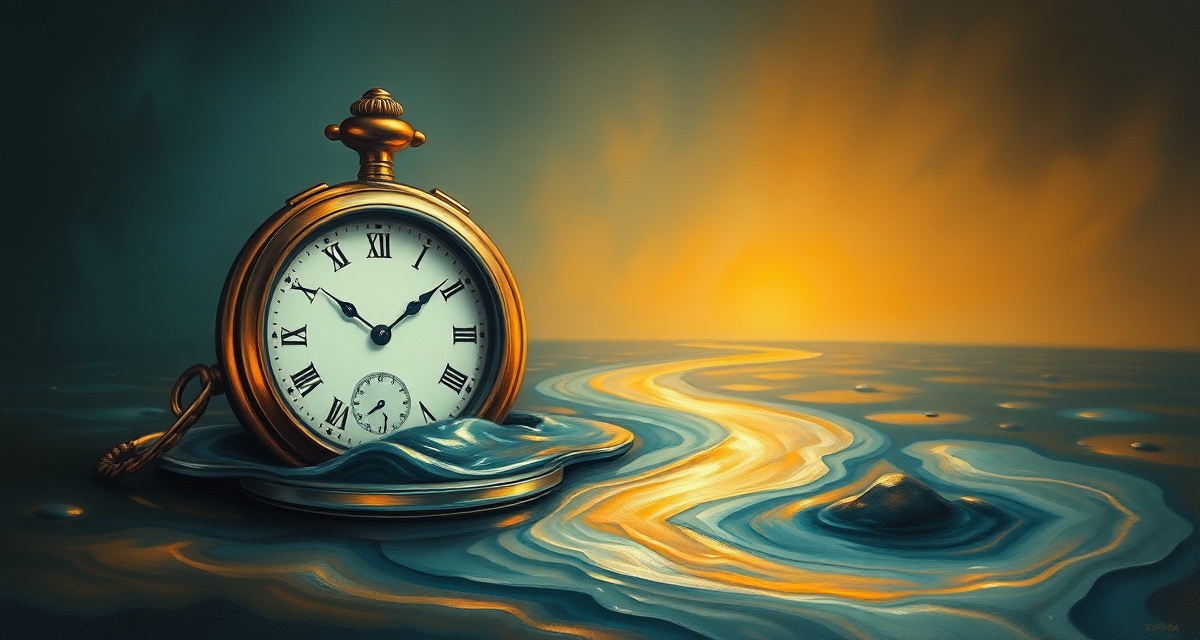
The time of the clock is spatial. We mark it with positions: twelve, three, six, nine. We add and subtract its units like inches on a ruler. We graph it as a line. When we speak of "ten minutes from now" or "an hour ago," we are pointing to coordinates on a line we have laid out in the imagination.
Bergson called this temps — time as represented, time treated as a kind of space. It is the time of physics, of schedules, of train timetables. It is real and useful. But it is not the time of lived experience.
Time as We Live It
When you are deeply absorbed in a conversation, three hours can pass and feel like thirty minutes. When you are bored in a waiting room, three minutes can feel like an hour. The clock has not slowed or sped up. Something else is happening — and that something else, Bergson argued, is real time, the time of consciousness itself.
He called it durée — duration. Duration is not made of discrete units that can be added together. It is qualitative, continuous, irreversible. The moment you are in right now is not a point on a line; it is a flowing present that includes the immediate past as memory and is already reaching toward what comes next.
Real duration, Bergson wrote in Time and Free Will, is what is felt as we listen to a melody. The melody is not a sequence of separate notes that you assemble in your mind. It is one unfolding gesture, in which each note carries the meaning of every note that came before.
If you tried to analyze a melody by isolating each note and measuring its duration in milliseconds, you would not be analyzing the experience of music. You would be analyzing something else — a spatial representation of the music. The thing itself would have slipped away.
Why the Distinction Matters
Bergson believed that the slide from duration to clock time was not merely a convenience but a philosophical mistake with serious consequences.
When you treat consciousness as a sequence of discrete moments, you lose the fact that consciousness is a flow. When you treat memory as a storage system that retrieves items, you lose the way the present moment is shot through with the past. When you treat human action as the outcome of forces measured in instants, you lose the felt experience of deciding.
The mistake, Bergson argued, is responsible for many of the puzzles that have haunted philosophy. Zeno's paradoxes — Achilles never catching the tortoise, the arrow that cannot move because at any instant it is at rest — work only if you assume time is composed of static points. In duration, motion is irreducible. The arrow does not stop and start; it flows.
Bergson and the Sciences
Bergson's distinction influenced fields far beyond philosophy. In psychology, William James's notion of the "stream of consciousness" owes a clear debt to Bergsonian duration. In literature, the long interior monologues of Proust and Virginia Woolf are attempts to render duration on the page rather than chronological clock time. In physics, the debate with Einstein turned on whether the "time" of physics had any genuine connection to the "time" of experience.
The physics debate is worth a moment. In 1922, Bergson published Duration and Simultaneity, arguing that special relativity's "time" was a kind of measurement, not the real time of lived experience, and that the famous twin paradox should be understood accordingly. Einstein responded politely but firmly: there is no time of philosophers, only the time of physics. Most physicists at the time, and most still, sided with Einstein. The cultural damage to Bergson was enormous.
But Bergson's deeper point — that there is a phenomenological dimension to time that physical measurement does not capture — has been quietly vindicated. Contemporary philosophy of time, neuroscience of time perception, and phenomenological work in the tradition of Husserl and Merleau-Ponty all recognize that the time of experience is not exhausted by the time of clocks.
A Practical Consequence
The Bergsonian distinction matters for how we think about our own lives.
Modern life has trained us to think in temps. We measure days in hours, productivity in minutes, attention in seconds. We say a moment "took" or "lasted" a certain length, as if time were a substance we possess and spend.
But the moments we remember most — the ones that constitute a life — are not measured in minutes. They are measured in the quality of their duration. A long phone call with someone who matters can fold an hour into an instant. A boring meeting can stretch ten minutes into an eternity. The "amount" of life you have is not, in the deepest sense, the number of hours you accumulate. It is the depth of duration you inhabit.
This is not just a romantic flourish. It has implications for attention, for relationships, for the design of work and rest. To live well, in Bergson's view, is partly to live in duration — to give yourself to the unfolding present rather than constantly measuring it against the clock.
A Philosopher Worth Recovering
Bergson's eclipse was overdetermined: the rise of analytic philosophy, the Einstein affair, the cultural shift after World War II away from the kind of literary metaphysics he wrote. But his central distinction is still alive, and still useful.
The clock is one way to measure time. It is not the only one. The time you actually live is not a line of identical moments but a flow that has shape, color, weight. That flow is the only time you ever directly know. The clock is a useful abstraction. Duration is the thing itself.