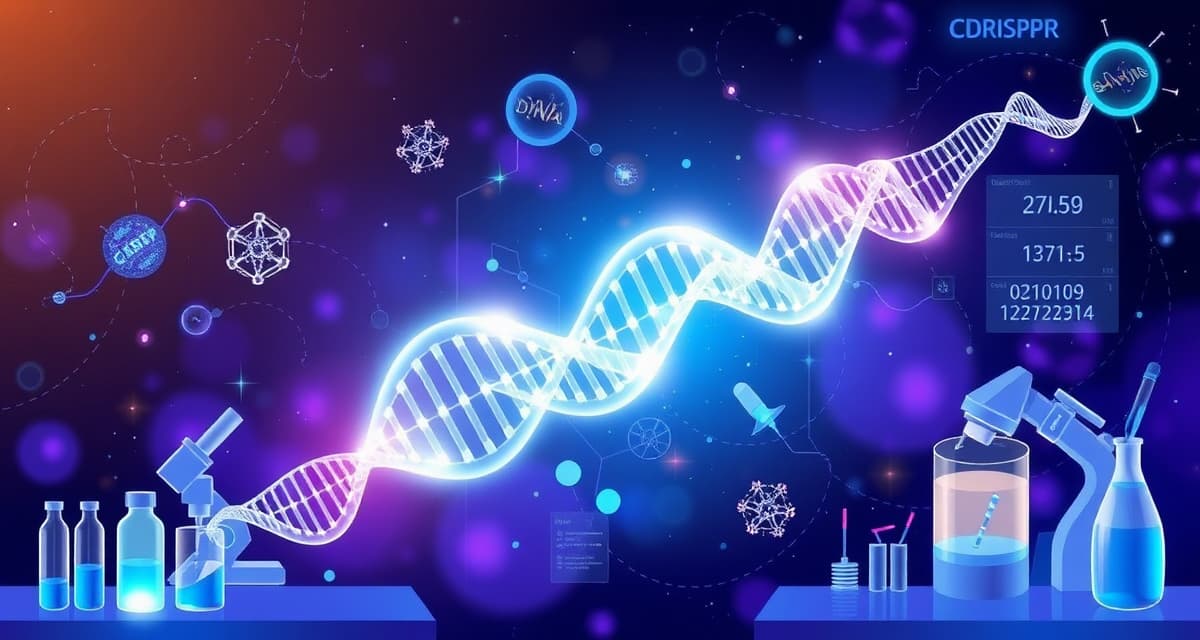
In 2012, Jennifer Doudna and Emmanuelle Charpentier published a paper in Science that changed biology. They demonstrated that a bacterial immune system component called CRISPR-Cas9 could be programmed to cut DNA at virtually any specific location. The implications were immediately recognized — and in 2020, Doudna and Charpentier received the Nobel Prize in Chemistry.
CRISPR has since become the most widely used gene-editing tool in the world. It is being applied to treat genetic diseases, engineer crops, study gene function, and — controversially — modify human embryos. But the mechanics of how it works are often poorly understood outside molecular biology.
The Bacterial Origin
CRISPR stands for Clustered Regularly Interspaced Short Palindromic Repeats — a name that describes a peculiar pattern found in bacterial DNA. Between repeated DNA sequences, bacteria store short fragments of viral DNA — molecular mugshots of past infections.
When a virus attacks again, the bacterium transcribes these stored fragments into RNA, which guides a protein called Cas9 (CRISPR-associated protein 9) to find and cut the matching viral DNA. It is, in essence, an adaptive immune system — bacteria remember their enemies and destroy them with molecular scissors.
What Doudna and Charpentier realized was that this system could be repurposed. By designing a synthetic guide RNA that matches any DNA sequence of interest, they could direct Cas9 to cut any gene in any organism.
How the Cut Works
The CRISPR-Cas9 system has two essential components:
The guide RNA (gRNA) is a short RNA molecule — typically about 20 nucleotides — designed to match the target DNA sequence. It works by base pairing: adenine pairs with thymine (or uracil in RNA), cytosine pairs with guanine. The gRNA finds its complement in the genome and binds to it.
The Cas9 protein is the molecular scissors. Once the guide RNA binds to the target DNA, Cas9 makes a double-strand break — cutting both strands of the DNA helix at the specified location.
What happens next depends on the cell's own repair machinery. Cells have two main ways to fix a double-strand break:
Non-homologous end joining (NHEJ) simply glues the broken ends back together. This process is error-prone — it often inserts or deletes a few nucleotides at the break site. These "indels" can disrupt the gene's reading frame, effectively knocking the gene out. This is the most common use of CRISPR in research: disabling a gene to see what happens.
Homology-directed repair (HDR) uses a template — either a natural sister chromosome or a synthetic DNA template provided by the researcher — to repair the break with precision. This allows specific sequences to be inserted, corrected, or replaced. HDR is more precise but less efficient, working well only in dividing cells.
What It Can Do Today
Disease research. CRISPR has become the standard tool for creating animal models of human genetic diseases. Need to study a mutation associated with Alzheimer's? You can introduce that exact mutation into a mouse genome in weeks, a process that previously took years of selective breeding.
Sickle cell disease. In 2023, the FDA approved Casgevy (exagamglogene autotemcel), the first CRISPR-based therapy for sickle cell disease. The treatment edits a patient's own blood stem cells to reactivate fetal hemoglobin production, compensating for the defective adult hemoglobin. Early results have been remarkable — patients who previously suffered severe pain crises have been crisis-free for over a year post-treatment.
Agriculture. CRISPR-edited crops are reaching the market. Unlike traditional GMOs, which typically insert foreign genes, CRISPR edits can make precise changes indistinguishable from natural mutations — a deletion here, a single nucleotide change there. This has prompted some regulators to treat CRISPR-edited crops differently from transgenic organisms.
Diagnostics. CRISPR-based diagnostic tools like SHERLOCK and DETECTR can identify specific DNA or RNA sequences with high sensitivity. During the COVID-19 pandemic, CRISPR diagnostics were developed that could detect SARS-CoV-2 RNA in under an hour without the complex equipment required for PCR.
The Limits
CRISPR is powerful but not perfect.
Off-target effects. The guide RNA can bind to DNA sequences that are similar but not identical to the intended target. When Cas9 cuts at these unintended sites, the results can range from harmless to potentially dangerous — particularly in therapeutic contexts where off-target edits could disrupt a tumor suppressor gene or activate an oncogene.
Delivery. Getting the CRISPR components into the right cells in a living organism remains one of the biggest practical challenges. For blood diseases, cells can be edited outside the body and reinfused. For diseases affecting the liver, brain, or muscle, delivery requires viral vectors or lipid nanoparticles — each with its own limitations.
Mosaicism. When CRISPR is applied to embryos or multicellular organisms, not every cell receives the edit. The result is a mosaic — some cells carry the edit, others don't. This complicates therapeutic applications and makes germline editing (editing that would be inherited by future generations) unpredictable.
Ethical boundaries. In 2018, He Jiankui announced that he had used CRISPR to edit human embryos, resulting in the birth of twin girls with a modified CCR5 gene — intended to confer resistance to HIV. The scientific community condemned the work as premature, poorly designed, and ethically unjustifiable. He was sentenced to three years in prison. The episode underscored that the technology has outpaced the ethical frameworks needed to govern it.
What Comes Next
The field is not standing still. Base editors, developed by David Liu's lab, can change one DNA letter to another without making a double-strand break — reducing off-target damage. Prime editing, also from Liu's lab, can make virtually any small edit (insertions, deletions, all twelve types of point mutations) without double-strand breaks or donor DNA. These next-generation tools are more precise than classical CRISPR-Cas9, though they are also newer and less thoroughly tested.
The trajectory is clear: the ability to read, write, and edit the code of life is becoming routine. The question is no longer whether we can edit genes. It is when, how carefully, and under what rules.