Pull out your phone, open a maps app, and within seconds a small blue dot appears on the screen, marking your location to within a few meters. The fact that this works at all is a small miracle of physics, engineering, and international cooperation. The fact that it would not work at all without Albert Einstein is the part most people do not realize.
GPS — the Global Positioning System — is one of the most successful applications of fundamental physics in everyday life. It is also one of the few practical technologies that depends on both of Einstein's theories of relativity. Without correcting for relativistic effects, your GPS position would drift by miles per day. The math that makes the blue dot land in the right place was worked out, in principle, more than a century before the first satellite was launched.
The Basic Idea
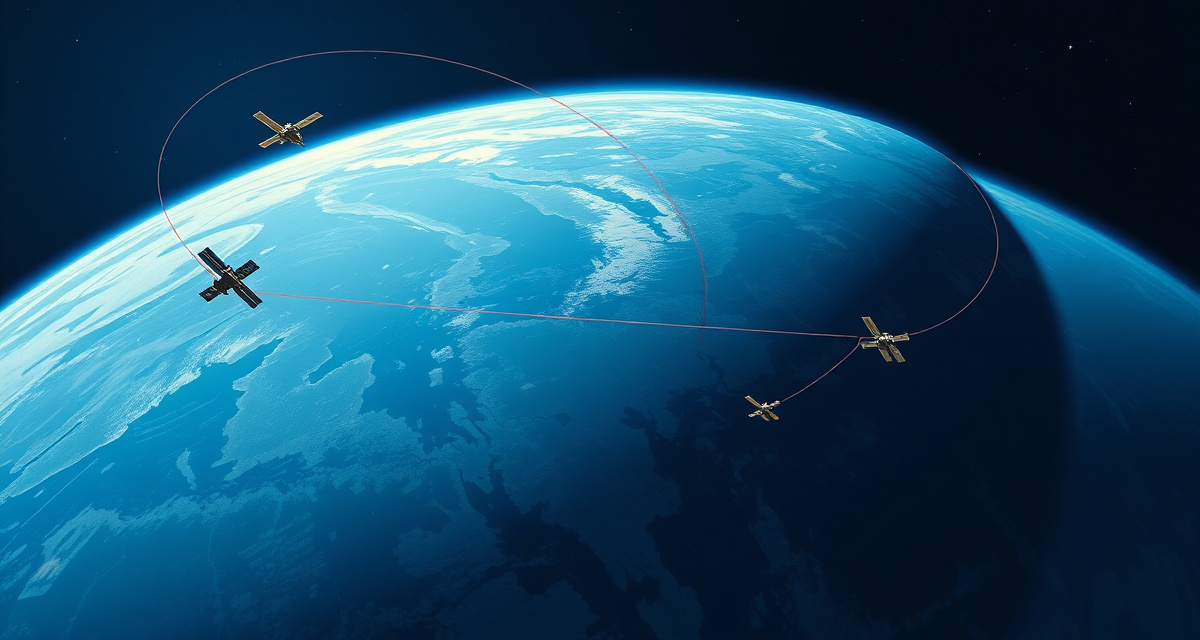
GPS works by trilateration. The system consists of a constellation of around thirty-one operational satellites in medium Earth orbit, each broadcasting a precise time signal and information about its own position. Your phone, watch, or car receiver does not transmit anything. It simply listens.
When the receiver picks up signals from at least four satellites, it does the following:
- Each satellite signal carries the exact time it was transmitted.
- The receiver compares this to the current time and computes how long the signal took to travel.
- Multiplied by the speed of light, this gives the distance to that satellite.
- With distances to at least four satellites, the receiver can solve for its own position in three dimensions, plus a correction for the receiver's clock error.
Three satellites are enough in principle to give a 3D position, but a fourth is needed because consumer receivers do not carry atomic clocks. The fourth signal lets the receiver solve simultaneously for position and the clock error in its own much-cheaper quartz timekeeper.
Why Timing Has to Be So Precise
Light travels at roughly 300,000 kilometers per second, or about 30 centimeters per nanosecond. That number is the engineering challenge of GPS in a nutshell. To know your position to within a few meters, you need to know the signal travel times to within a few tens of nanoseconds.
This is why every GPS satellite carries multiple atomic clocks — usually rubidium and cesium standards — that are synchronized to ground reference clocks. The clocks must be stable to better than 1 part in $10^{13}$, drift no more than a few nanoseconds per day, and remain coordinated across the entire constellation. The whole system is, fundamentally, a triumph of clock-making.
But timekeeping at this level of precision runs into a problem that did not exist for older navigation technology. The clocks on the satellites and the clocks on the ground do not run at the same rate. Two effects, both predicted by relativity, produce the discrepancy.
Where Einstein Comes In
Special relativity says that a clock moving relative to an observer ticks slower than a stationary clock. GPS satellites move at about 14,000 kilometers per hour relative to the ground. At that velocity, the time-dilation effect is small but measurable: the satellite clocks lose about 7 microseconds per day relative to ground clocks because of their motion.
General relativity says that a clock in a stronger gravitational field ticks slower than one in a weaker field. GPS satellites orbit at about 20,200 kilometers above Earth's surface, where the gravitational field is much weaker than at the ground. This causes the satellite clocks to gain about 45 microseconds per day relative to ground clocks.
The two effects act in opposite directions. The net result is that GPS satellite clocks run fast by approximately:
45 µs/day (general relativity) − 7 µs/day (special relativity) = 38 µs/day
That is the gap that has to be corrected. And 38 microseconds per day, multiplied by the speed of light, is roughly 11 kilometers per day. Without correction, your GPS position would degrade by miles per day. The phone that tells you to turn left at the next intersection works only because Einstein's equations are correct.
The relativistic correction is built into the satellite electronics. The satellites' clocks are deliberately tuned to run slightly slow before launch, so that once they are in orbit, the relativistic effects bring them into agreement with ground time. The correction was worked out in detail before the first GPS satellite launched in 1978, by physicists who took relativity seriously enough to bake it into the hardware.
Sources of Error
A handful of effects, beyond relativistic timekeeping, conspire to limit GPS accuracy.
Atmospheric delay. Signals slow slightly as they pass through the ionosphere and troposphere. High-end receivers correct for this using dual-frequency signals; consumer receivers use a model.
Multipath. Signals can reflect off buildings before reaching your receiver, arriving as if from a different direction. This is why GPS is famously flaky in dense urban "canyons."
Ephemeris errors. The satellite's broadcast position is not perfect. Errors of a few meters in the satellite's reported position propagate into errors in your computed position.
Receiver noise. Quartz clocks are not perfect, antennas are not perfect, and computation introduces small errors.
Stack these together and a typical consumer GPS gets you to within roughly 3 to 5 meters of true position under good conditions. Survey-grade GPS, using techniques like differential GPS or real-time kinematic positioning, can achieve centimeter accuracy.
Beyond GPS
GPS, strictly speaking, is the U.S.-operated system. It is one of several Global Navigation Satellite Systems in use today: GLONASS (Russia), Galileo (European Union), BeiDou (China), and others. Modern phones often listen to multiple constellations at once, which improves accuracy and reliability. The principles are the same.
The newer systems are also more demanding. Galileo and BeiDou have tighter timing standards. Their satellites' atomic clocks are more accurate. The relativistic corrections are more refined. The whole infrastructure has continued to mature in ways most users will never notice.
What It All Adds Up To
GPS is one of the rare cases where the entire stack — the physics, the engineering, the economics, the international cooperation — works. It is a system that depends on:
- The constancy of the speed of light.
- Special relativity's time dilation.
- General relativity's gravitational time dilation.
- Atomic clocks accurate to one part in $10^{13}$.
- Thirty-plus satellites maintained in stable orbits.
- Receivers cheap enough to put in your pocket.
When you watch the blue dot move across the screen as you walk, you are watching a real-time application of the deepest theories physics has produced about how space, time, and gravity actually work. Most users never give it a second thought. That is, in its own way, the highest compliment science can be paid: that its strangest and most counterintuitive results have been domesticated so thoroughly that we trust them without thinking.
The next time the directions you are following seem ordinary, remember: the only reason they are right is that Einstein was right.