Charles Darwin called the eye a "supreme difficulty" for his theory. He didn't doubt it had evolved — he gave a careful argument for how it could have. But he understood why it gave readers pause. The eye is intricate, layered, and tightly integrated. Imagining it appearing all at once is impossible. Imagining it forming gradually, with every intermediate stage useful, requires patience and biology.
Modern research has done what Darwin could only sketch. It turns out the eye has evolved independently somewhere between 40 and 65 times across animal lineages. Each time, evolution has converged on similar functional designs, often through entirely separate molecular and cellular routes. The eye is not one improbable invention. It is one of the most repeatedly invented structures in life history.
What "Eye" Actually Means
Before counting, the term needs precision. Biologists distinguish several levels of light-sensing structures:
- A photoreceptor cell — a single cell capable of detecting light. These exist in nearly every multicellular animal lineage, in many plants and protists, even in some bacteria.
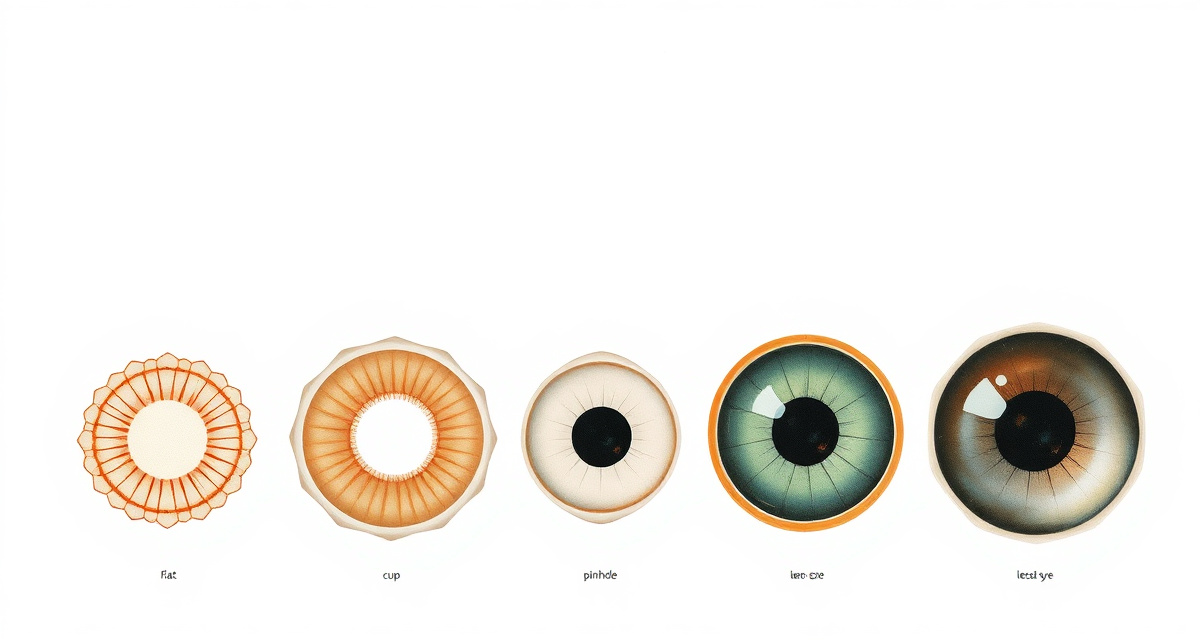
- A simple eye spot — a patch of photoreceptor cells, often shaded by pigment, capable of detecting direction or intensity but not forming an image.
- A proto-eye with primitive optics — a cup or pinhole structure that begins to localize light from particular directions.
- A true image-forming eye — featuring a lens, focusing apparatus, and a receptor surface able to spatially resolve patterns.
When biologists say the eye has evolved "40+ times," they typically mean image-forming or near-image-forming structures, of which there are at least eight major morphological types.
The Eight (Or So) Major Designs
The first detailed survey of eye types was published by Michael Land and Dan-Eric Nilsson, building on a long history of comparative morphology. Their canonical list includes:
Pinhole eyes — found in Nautilus, a chambered cephalopod. No lens at all; just a small aperture and a retina. Crude but functional.
Single-lens (camera) eyes — found in vertebrates and, separately, in cephalopods like octopus and squid. A single lens focuses light onto a retina. The vertebrate and cephalopod versions are strikingly similar despite evolving completely independently. The cephalopod retina is, in some ways, more elegantly arranged — its photoreceptors face the incoming light directly, while ours face away from it (a quirk of vertebrate development that gives us a blind spot).
Compound eyes — found in arthropods. Many small ommatidia, each with its own lens, tile a curved surface. They give wide visual fields and excellent motion detection at the cost of resolution.
Mirror eyes — found in scallops. Light is focused by a curved reflective layer behind the retina. (Scallops have dozens of these, around the rim of their shell.)
Reflector superposition eyes — in shrimp and lobsters, using arrays of mirrors rather than lenses.
Refracting superposition eyes — in nocturnal moths and other crepuscular insects, gathering light across many facets to achieve sensitivity in low light.
Apposition compound eyes — the more familiar diurnal-insect type.
Each of these solves the problem of "see the world" with different optical and developmental machinery.
Convergence at the Molecular Level
For decades, the standard textbook conclusion was that eyes evolved many times entirely independently. Then in the 1990s, a striking finding complicated the picture.
Walter Gehring and his colleagues showed that a master regulatory gene, Pax6 (in vertebrates) — and its homolog eyeless (in fruit flies) — is required for eye development across an enormous range of animals. Switch on eyeless in a fly's leg, and you get an extra eye on the leg. Insert mouse Pax6 into a fly, and it still triggers eye development.
This suggests that while the external designs of eyes are convergent, the underlying genetic toolkit — the deep regulatory architecture for "build a light-sensing organ here" — is shared across an enormous swath of animal life. The molecule we call opsin (the protein that absorbs photons) appears in early animal lineages and was likely present in the common ancestor of all bilaterians, more than 500 million years ago.
This is a more interesting story than either pure independent evolution or single-origin design. The hardware is reinvented many times. The deep genetic switches that say "vision goes here" are largely shared.
Nilsson and Pelger's Calculation
In 1994, Dan-Eric Nilsson and Susanne Pelger published one of the most influential calculations in evolutionary biology. They asked: starting from a flat patch of light-sensitive cells, how long would it take for selection to produce a fully focused, lens-bearing camera eye?
They modeled small, plausible mutations — slight curvature of the patch, a slight constriction of the aperture, a slight refractive index gradient in the protective tissue — and assumed each mutation conferred a 1% selective advantage if it improved visual acuity.
Their estimate: fewer than 364,000 generations to go from a light-sensitive patch to a fully focused eye.
For organisms with one-year generation times — which is on the slow end for early metazoans — that's around 350,000 years. A geological eye-blink. Eyes do not need hundreds of millions of years to evolve. They need a fraction of a million.
Imperfections That Reveal History
If eyes were designed from scratch each time for optimal performance, you'd expect them to look optimal. They don't always.
The vertebrate retina is famously "inverted." Photoreceptors face the back of the eye; light has to pass through layers of supporting cells and blood vessels before reaching them. Where the optic nerve exits, you have a literal blind spot. This is a quirk of how vertebrate eyes develop from the embryonic neural tube, locked in early and never refactored.
The cephalopod retina, evolving from a different developmental pathway, has its photoreceptors facing forward, and no blind spot.
These imperfections are exactly what evolutionary biology predicts: each lineage builds its eye from whatever developmental machinery happens to be at hand, and the result reflects history more than perfect engineering.
Why It Matters
The repeated evolution of eyes is one of the strongest demonstrations of how natural selection actually works. It is not a single freak miracle to be defended. It is a structural pattern: when light is available and an organism can do something useful with it, evolution finds eyes — over and over, with whatever materials are around.
Darwin would have recognized the answer. He just couldn't see, in 1859, how thoroughly the empirical evidence would line up. Today the eye is not a "supreme difficulty" for evolution. It is one of its most repeated, well-documented case studies.