Your body is constantly performing a feat of molecular engineering so precise it borders on the unbelievable. Every time a cell divides — and roughly 25 million cells divide every second in the human body — it must copy approximately three billion base pairs of DNA with an error rate of less than one mistake per billion letters copied. For comparison, a professional typist copying a document makes roughly one error per thousand characters.
How does a biological system achieve an accuracy that vastly exceeds what any human process can manage? The answer involves multiple overlapping mechanisms, and understanding them illuminates one of the deepest principles in molecular biology: biological precision is not engineered directly, but achieved through layers of correction.
The Basic Machinery of Replication
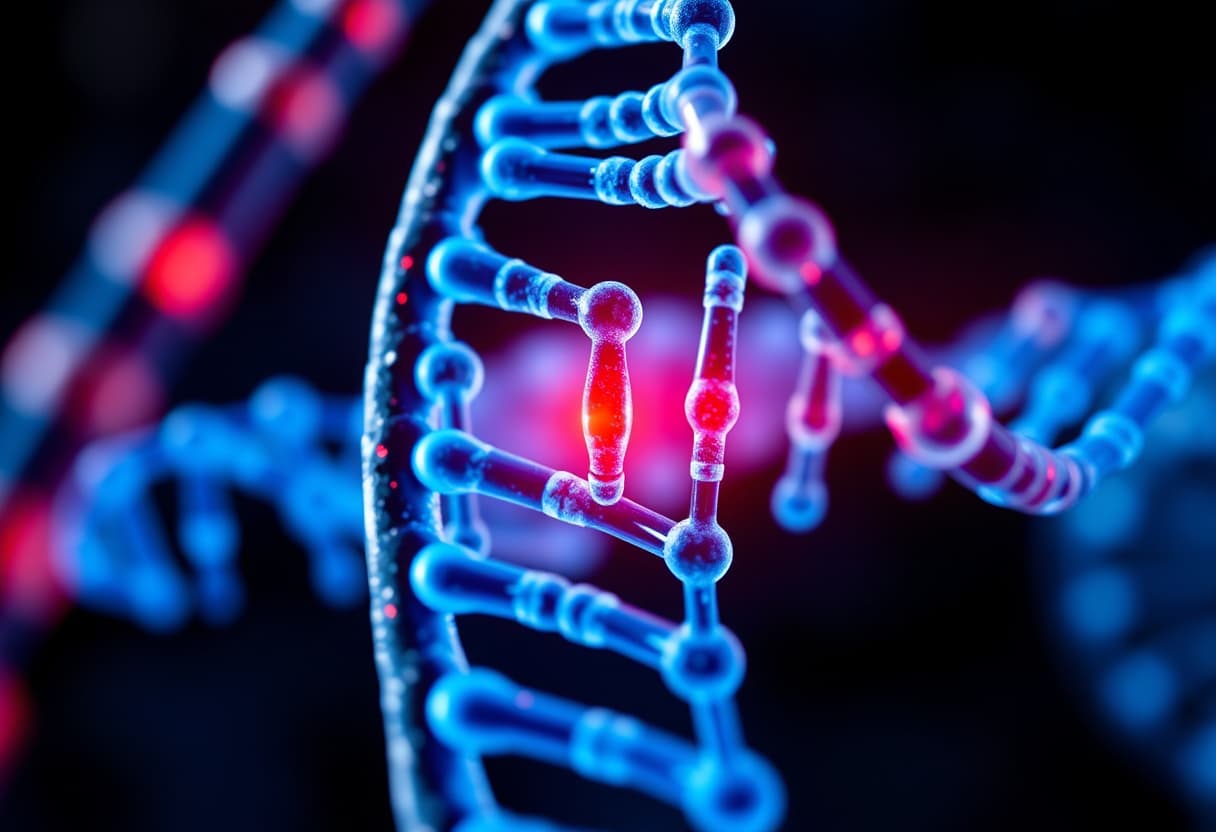
DNA replication begins when an enzyme called helicase unwinds and separates the double helix, exposing each strand as a template. The primary copying enzyme, DNA polymerase, then moves along each strand, reading the template and assembling a complementary strand by selecting and inserting matching nucleotide bases — adenine pairs with thymine, cytosine pairs with guanine.
DNA polymerase is already selective: it preferentially binds the correct nucleotide and pauses when it encounters a mismatch. But its raw error rate — before any correction — is estimated at roughly one mistake per 100,000 base pairs inserted. This sounds impressive but would be catastrophic across a 3-billion-base genome.¹
The critical improvement comes from a built-in proofreading function. DNA polymerase can run in reverse, detecting when it has just inserted the wrong base (a mismatch changes the geometry of the DNA strand in a detectable way) and excising the error before continuing forward. This proofreading step reduces the error rate by roughly 100-fold — to approximately one error per 10 million base pairs.
Mismatch Repair: The Second Layer
Even after proofreading, some errors escape. These are caught by a separate system called mismatch repair (MMR), which scans newly replicated DNA for distortions in the helix geometry that indicate base-pair mismatches.
The MMR system is elegant in design: it must repair errors without destroying both strands (which would erase information entirely). It solves this by distinguishing the newly synthesized strand from the original template strand. In bacteria, this is accomplished through methylation patterns — the old strand is chemically marked and the new strand is not yet marked, allowing the repair machinery to identify which strand contains the error and excise a section of the new strand surrounding the mismatch for resynthesis.²
The cell doesn't just copy its DNA — it proofreads the copy, then proofreads the proofreading. Accuracy is not a single process but a cascade of error-correction.
In humans, the MMR mechanism is more complex, but the principle holds. Together, polymerase proofreading and mismatch repair reduce the final error rate to approximately one mistake per billion base pairs — the extraordinary figure that allows cell division to proceed without rapid accumulation of catastrophic mutations.
When the System Fails
Understanding DNA repair mechanisms has direct medical relevance, because failures in these systems are implicated in cancer.
When mismatch repair genes are mutated or silenced, cells accumulate replication errors at far higher rates. This condition, called microsatellite instability, is a characteristic feature of a subset of colorectal, endometrial, and other cancers — including Lynch syndrome, a hereditary condition caused by inherited mutations in MMR genes. Individuals with Lynch syndrome have a significantly elevated lifetime risk of certain cancers precisely because their DNA error-correction is compromised.³
This connection between repair defects and cancer illustrates a core principle: the extraordinary accuracy of normal DNA replication is not merely interesting — it is existential. A cell lineage that accumulates mutations too quickly rapidly loses functional integrity. The elaborate machinery of error correction is what makes stable, long-lived multicellular organisms possible.
Beyond Replication: Other Forms of DNA Damage
Replication errors are only one source of DNA damage. Throughout the life of a cell, DNA is also damaged by ultraviolet radiation (which causes thymine dimers — abnormal links between adjacent thymine bases), oxidative damage from metabolic byproducts, ionizing radiation, and various chemical mutagens.
For each type of damage, cells have specialized repair pathways. Nucleotide excision repair handles bulky lesions like thymine dimers — it works somewhat like a spell-checker that cuts out a section of text surrounding a corrupted word and resynthesizes the correct sequence. Base excision repair handles smaller modifications to individual bases. Double-strand break repair handles the most severe form of DNA damage, in which both strands are broken, using either precise templated repair (from a sister chromatid) or error-prone joining of broken ends.⁴
The existence of so many overlapping repair systems reflects how central genome integrity is to cellular survival. The cell has not one line of defense against mutation, but many — each tuned to a different type of damage, operating at different stages of the cell cycle.
The Imperfection That Makes Evolution Possible
There is an important counterpoint to all of this. Perfect fidelity would have its own cost: if DNA replication were absolutely error-free, there would be no source of heritable genetic variation, and evolution by natural selection would stall. The error rate of roughly one per billion base pairs is not just the best biology can achieve — it may be close to the optimal rate for a given organism's genome size and generation time, balancing the need for stability against the need for variation.
Mutations are not only a threat to the individual cell. In the long run, across populations and generations, they are the raw material that allows life to adapt. The same machinery that keeps an individual organism alive by minimizing replication errors is, at a population level, the source of the variation that allows species to evolve.
The cell's DNA repair systems are among the most sophisticated molecular machines in all of biology — and they exist, in part, to hold imperfection to an exquisitely calibrated minimum.
Sources
¹ Bruce Alberts et al. — Molecular Biology of the Cell (6th ed., 2014), W.W. Norton & Company
⁴ Errol Friedberg et al. — DNA Repair and Mutagenesis (2nd ed., 2006), ASM Press