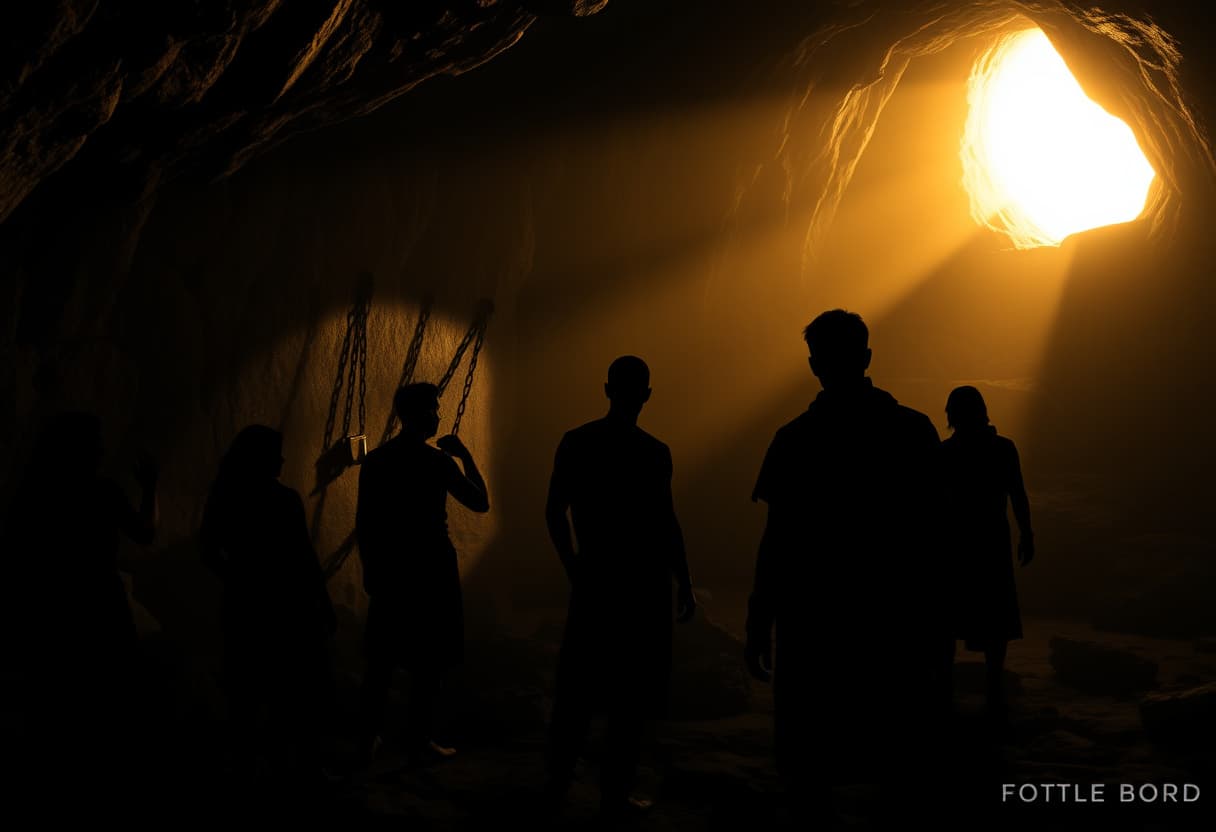
Book VII of Plato's Republic opens with one of the most remarkable thought experiments in the history of philosophy. Imagine, Socrates tells Glaucon, a group of prisoners who have been chained in an underground cave since childhood — their legs and necks fixed so they can only look at the wall in front of them.
Behind them, a fire burns. Between the fire and the prisoners, people pass by carrying various objects, whose shadows are projected onto the cave wall. The prisoners, who have never seen anything else, take these shadows to be reality. They name them, track their sequences, and consider themselves knowledgeable about the world.
What happens when one prisoner is freed?
The Ascent
The freed prisoner is turned toward the fire. It hurts. The light is blinding after a lifetime of shadow. The objects behind him are more real than their shadows, but they're difficult to look at. He is dragged up out of the cave — painfully, against his will — into sunlight.
This, too, is agonizing. He cannot see at first. Gradually, he adjusts: he can see shadows, then reflections in water, then objects directly, then the night sky, and finally the sun itself — which Plato identifies with the Form of the Good, the highest reality, the source of all intelligibility and value.
And then: he goes back down.
What the Allegory Claims
The cave is a philosophical argument in narrative form. Plato is making several related claims:
Most human knowledge is analogous to shadow-watching. The objects of ordinary experience — the physical world of sense perception — are not the deepest reality. They are, in Platonic terms, imperfect instances of Forms: eternal, unchanging, perfect archetypes of which physical things are imitations. The chair I sit in is real enough for practical purposes, but it participates imperfectly in the Form of Chair. Understanding reality fully requires moving beyond the particular to the universal.
Education is not information transfer. Plato explicitly states this: "Education is not what some proclaim it to be — they claim to put knowledge into souls that lack it, as though they were putting sight into blind eyes." True education is the turning of the whole soul — the reorientation of attention and desire from shadows to light. It is not adding content; it is changing direction.
The philosopher's obligation is return. This is perhaps the most important and counterintuitive element. The person who has seen the sun — who has attained genuine philosophical understanding — will not want to go back to the cave. The ordinary concerns of politics and reputation will seem trivial by comparison with the realities they've encountered.
But in the Republic, the philosopher-kings must return. The just city requires people who have seen the Forms to govern it. Philosophy is not finally about private illumination but about the common good.
The prisoner who returns to the cave will see worse than those who never left. Adjusting to the light has made them blind to the dark.
The Problem of Returning
There is a poignant detail in the allegory. When the philosopher goes back down and tries to describe what they've seen, the other prisoners think they've gone blind. The person who insists that the shadows are not reality — who describes sunlight and actual objects to people who have never experienced them — will be met not with wonder but with contempt, even danger.
Plato is clearly thinking of Socrates. The philosopher who insisted on truth over comfortable illusion was tried, convicted, and executed. The allegory acknowledges this directly: the prisoners would kill anyone who tried to release them.
This is not merely a comment on ancient Athens. Any serious encounter with a reality that contradicts the assumptions of your social world will produce resistance — from others, and from yourself. The turning of the soul is painful at every stage.
The Allegory After Plato
The cave has been appropriated by nearly every subsequent Western philosophical tradition for its own purposes. Descartes uses a different setup but the same basic problem: how do we distinguish appearance from reality? Christian Neoplatonists used the allegory to describe the soul's ascent to God. The Gnostics ran with the idea in radical directions. Contemporary philosophers of mind debate whether our perceptual experience of the world accurately represents underlying reality.
The deepest question Plato leaves us with is not primarily epistemological but practical: What are your chains? What would it mean to turn around? And what would you do with the sunlight if you found it?
¹ Plato — Republic, Book VII (trans. G.M.A. Grube, rev. C.D.C. Reeve, 1992, Hackett) ² Julia Annas — An Introduction to Plato's Republic (1981, Oxford University Press) ³ C.S. Lewis — The Abolition of Man (1943/2001, HarperCollins)