Plato's theory of Forms is one of the most influential and most caricatured ideas in Western philosophy. Caricatured, because the popular version — there's a perfect chair in some other dimension — misses what Plato was actually trying to explain. Influential, because nearly every metaphysical debate that followed, from medieval realism to modern questions about mathematical objects, sits in some position relative to the theory of Forms.
It is worth taking seriously, even if you end up rejecting it.
The Problem Plato Was Trying to Solve
Start with a question that seems too simple to bother with: how do we know two different chairs are both chairs?
A wooden dining chair, a plastic schoolroom chair, and a moulded carbon-fiber office chair share almost no physical properties. They differ in shape, color, weight, material, and history. Yet you have no trouble grouping them under one concept. More striking: an alien who had never seen any of them would, with the right description, also recognize them as chairs.
Where, exactly, is chairness? It is not in any one chair. It is not the sum of the chairs (chairs may be destroyed, but the concept of chair persists). It does not seem to be only in our heads, because chairs were chairs before any human looked at one of them, and the structure of what counts as a chair feels discovered, not invented.
This is a version of what philosophers call the problem of universals — and Plato's theory of Forms is one of the earliest, boldest answers to it.
What the Forms Are
For Plato, every meaningful concept — chair, justice, triangle, beauty, good — corresponds to a Form (εἶδος, eidos, sometimes also idea). The Forms are:
- Real — not products of the mind. They exist whether or not anyone thinks about them.
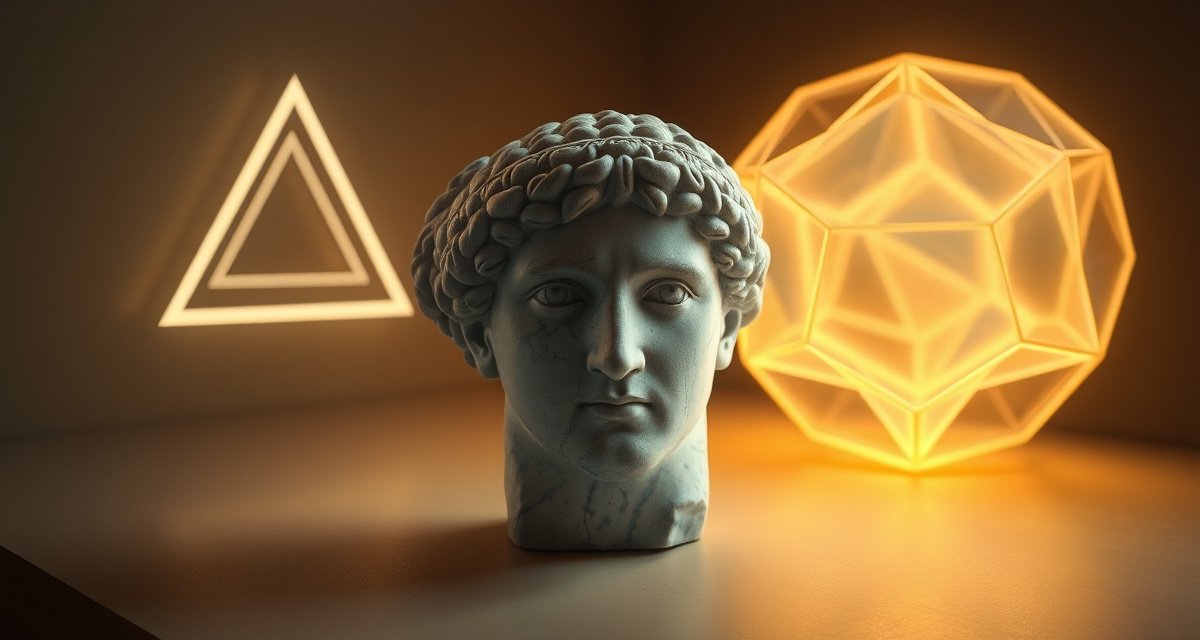
- Perfect — fully and completely what they are. The Form of the Triangle is triangularity itself, undistorted by any particular wobbly drawing.
- Unchanging — eternal, beyond time and decay.
- Non-spatial — they are not located anywhere; they are not made of matter at all.
- The cause of resemblance — particular things in our world are what they are by participating in (μέθεξις, methexis) the relevant Form.
A particular drawn triangle resembles a triangle because it participates in Triangleness. A particular act is just because it participates in Justice. A face is beautiful insofar as it participates in Beauty itself.
Why Plato Believed in Them
Plato had several intertwined arguments. Three are worth understanding.
1. The argument from mathematics. Mathematical truths feel discovered, not invented. The Pythagorean theorem holds universally and was true before any geometer wrote it down. But the perfect triangles and circles of geometry don't exist in the physical world — every drawn triangle is approximate. Yet our reasoning about the triangle is exact. Plato concludes there must be exact, non-physical objects of mathematical knowledge. The Forms.
2. The argument from definition. When Socrates asks "What is justice?" or "What is courage?" in the early dialogues, he is not asking for a list of just acts. He wants the definition — the single account that captures what makes any just thing just. If such a definition is real, the thing it picks out must be real too.
3. The argument from imperfection. Particular things in our world are imperfect, changing, and partially what they are. A particular circle is roughly circular. A particular act is partially just. Plato argues that recognizing imperfection presupposes a standard against which it falls short — and that standard cannot be itself imperfect. So the standard, the perfect Form, must exist somewhere.
The Allegory of the Cave
Plato's most famous illustration of the theory comes in Republic Book VII. Prisoners are chained in a cave, watching shadows cast on a wall by figures passing in front of a fire. They take the shadows for reality. One prisoner is freed and dragged out into the sunlight. At first he is blinded. Slowly he comes to see the actual figures, then trees and the world, and finally — when his eyes adjust — the sun itself, the source of all visibility.
The shadows are sensory experience. The figures are particular things in the world. The world outside is the realm of Forms. The sun is the Form of the Good, which Plato says is the highest of all the Forms — that which gives intelligibility and being to all the others, as the sun gives visibility to all things.
The cave is not a metaphor for ignorance versus education. It is a claim about reality. Most of what people take to be most real — sense experience, opinion, particular objects — is the least real layer. The most real things are the most abstract.
Aristotle's Response
Plato's brilliant student Aristotle thought the theory of Forms was a beautiful mistake. Aristotle accepted that there are universals — there is something genuinely shared by all triangles, all chairs, all just acts. But he denied that universals exist separately from the particulars that exhibit them.
For Aristotle, triangleness is not in some non-spatial realm. It is the form (in a different, embedded sense) of every actual triangle. There is no universal Triangle floating apart; there are only triangles, and triangleness exists in them.
This immanent realism, against Plato's transcendent realism, became the dominant alternative — and the medieval debate between Aristotelian and Platonic realism shaped Christian theology for centuries.
Why It Still Matters
You don't have to accept the theory of Forms to see why it endures. The questions Plato was trying to answer have not gone away.
- Mathematicians still argue about whether mathematical objects are discovered or invented.
- Philosophers of science still debate whether laws of nature are universal abstract entities or generalizations from particulars.
- Linguists and cognitive scientists still puzzle over how concepts work and what makes categories cohere.
- Ethicists still ask whether moral standards are real features of the world or human constructions.
Each of these is, in part, a return to the problem of universals. Plato's answer is one of the most ambitious ever offered. Whether or not the Forms exist, recognizing the question they were meant to answer is the beginning of taking philosophy seriously.