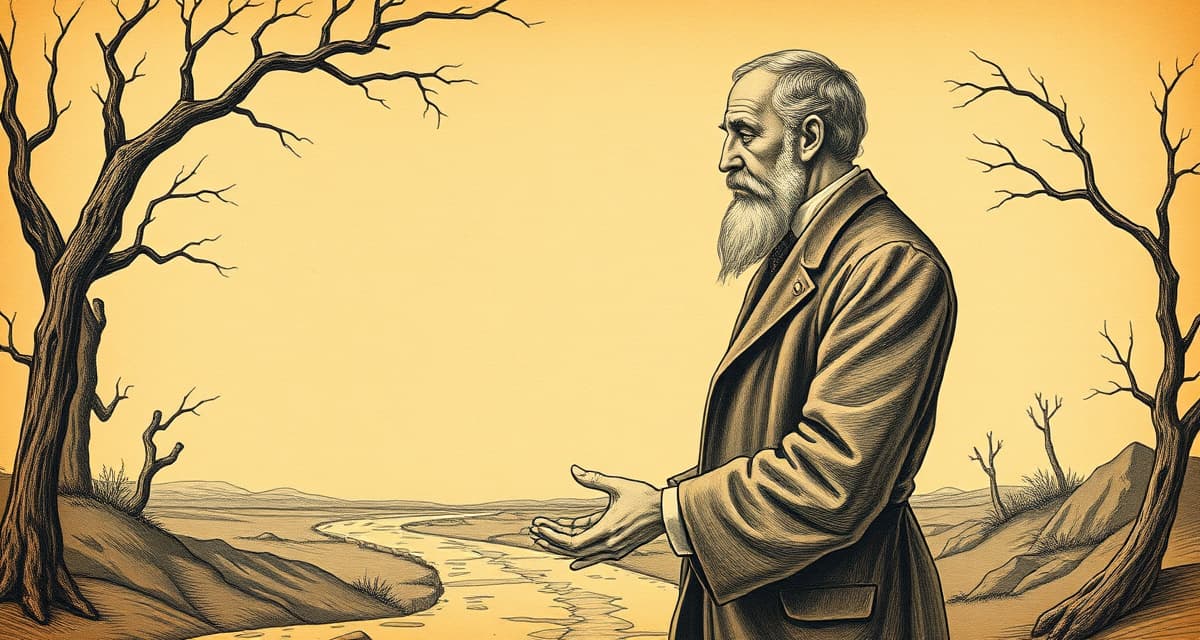
In the late nineteenth century, American philosophy was drowning in abstraction. European idealism dominated the universities, and most philosophical debates felt disconnected from anything a person might actually care about. Then William James — psychologist, physician, and public intellectual — proposed a radical test for ideas: Does it make a difference in practice?
This was the birth of pragmatism, the most distinctively American philosophical movement, and its central question remains as sharp today as it was in 1898.
The Origin of the Word
The term "pragmatism" was coined by Charles Sanders Peirce in the 1870s, during informal meetings of the "Metaphysical Club" at Harvard — a group that included Peirce, James, Oliver Wendell Holmes Jr., and other Cambridge intellectuals. Peirce's original formulation was narrow and technical: the meaning of a concept is exhausted by the practical effects of the objects it describes.
Peirce later distanced himself from what James did with the idea, even renaming his own version "pragmaticism" — a word, he said, "ugly enough to be safe from kidnappers." But it was James who made pragmatism famous, and James's version that shaped the public conversation.
James's Big Move
In his 1907 book Pragmatism: A New Name for Some Old Ways of Thinking, James laid out his position with characteristic clarity and provocation. He argued that truth is not a static property of ideas. An idea is true insofar as it "works" — insofar as it helps us navigate experience, solve problems, and connect successfully with reality.
"The true is the name of whatever proves itself to be good in the way of belief," James wrote, "and good, too, for definite, assignable reasons."
This was explosive. Critics accused James of reducing truth to usefulness, of saying that any belief that makes you feel good is therefore true. But James's position was subtler than the caricature. He didn't claim that wishing makes things so. He claimed that truth is a property of ideas in action — that we discover truth not by gazing at eternal forms but by testing ideas against experience and observing what follows.
Consider two rival scientific hypotheses. For James, calling one "true" means that it guides prediction, organizes evidence, and connects with other established truths better than the alternative. Truth isn't a medal awarded to ideas by a cosmic judge. It's a name we give to ideas that do the work of connecting us to reality.
The Pragmatic Method
James described pragmatism not as a doctrine but as a method — a way of settling disputes that might otherwise be interminable.
His example: two people argue about whether a man who walks around a tree, while a squirrel on the tree's trunk always keeps the trunk between itself and the man, has "gone around" the squirrel. In one sense (spatial), yes — the man has been north, east, south, and west of the squirrel. In another sense (relational), no — the man has never been behind the squirrel relative to the squirrel's own orientation.
The pragmatic method asks: what practical difference would it make if one answer were true rather than the other? If there's no practical difference, the dispute is empty. If there is, the difference itself points to the answer.
This method doesn't resolve every question, but it powerfully clears away disputes that are verbal rather than real. Much of what passes for deep philosophical disagreement, James argued, is actually ambiguity in language.
John Dewey and the Democratic Turn
James's colleague John Dewey took pragmatism in a more social and political direction. For Dewey, the pragmatic test applied not just to abstract ideas but to institutions, practices, and policies. Education, democracy, and social reform were all forms of inquiry — experiments in collective living that should be evaluated by their results.
In Democracy and Education (1916), Dewey argued that the purpose of education is not to transmit fixed knowledge but to develop the capacity for inquiry — the ability to identify problems, propose solutions, test them, and revise. This is pragmatism applied to learning.
Dewey's influence on American public education was enormous and is still debated. But his core insight remains powerful: ideas that don't connect to practice are incomplete, and practices that don't submit to evaluation are arbitrary.
The Rivalry with Rationalism and Empiricism
James positioned pragmatism as a middle way between two dominant traditions:
Rationalism — the view that fundamental truths are known through reason alone, independent of experience. Rationalists tend toward system-building, abstract principles, and certainty.
Empiricism — the view that all knowledge comes from sensory experience. Empiricists tend toward skepticism, particulars, and tentativeness.
James argued that both traditions had something right but were incomplete. Rationalism captured the human need for coherence and unity but became disconnected from lived experience. Empiricism honored experience but could become fragmented and directionless.
Pragmatism, James claimed, could be "both empiricist in its emphasis on experience and rationalist in its concern for systematic results." It took facts seriously while remaining open to the possibility that some beliefs are justified by their fruits rather than their origins.
Common Misconceptions
"Pragmatism says truth is whatever works for you." This misreads James. He didn't endorse individual wish-fulfillment. An idea "works" only if it survives contact with reality — if it predicts accurately, coheres with other truths, and doesn't collapse under scrutiny. A comforting delusion doesn't work in the long run because reality eventually pushes back.
"Pragmatism has no room for moral principles." Dewey, especially, was deeply committed to moral inquiry. The pragmatist claim is not that morality is arbitrary but that moral principles should be tested by their consequences in human life — not accepted dogmatically and applied regardless of context.
"Pragmatism is anti-intellectual." On the contrary, pragmatism demands more rigorous thinking, not less. It insists that abstract ideas justify themselves through engagement with reality rather than hiding behind jargon or tradition.
The Legacy
Pragmatism shaped the twentieth century in ways that are easy to underestimate. It influenced legal realism (Holmes's view that law is what courts do, not what textbooks say), progressive education (Dewey's experimental approach), the philosophy of science (Thomas Kuhn acknowledged pragmatist themes), and contemporary neopragmatism (Richard Rorty and Hilary Putnam, who extended and debated the tradition through the end of the century).
More recently, pragmatist ideas appear in the effective altruism movement's emphasis on measurable outcomes, in design thinking's iterative approach to problem-solving, and in the broader cultural trend toward "evidence-based" practice in medicine, policy, and education.
Why It Still Matters
The pragmatic question — what difference does it make? — is a surprisingly powerful filter. It cuts through jargon, exposes empty distinctions, and redirects attention from theoretical elegance to actual consequences.
It doesn't answer every question. Some of the deepest human concerns — the meaning of suffering, the existence of God, the nature of beauty — resist reduction to practical consequences. James knew this, which is why he wrote The Varieties of Religious Experience with deep sympathy for questions that couldn't be settled by experiment alone.
But as a starting point for inquiry, as a first question before committing to a position or a policy or a belief — "does this actually work, and how would I know?" — pragmatism remains one of the sharpest tools in the philosopher's kit.