In 1952, the British philosopher and mathematician Bertrand Russell wrote a short essay for Illustrated magazine titled "Is There a God?" The piece was commissioned and never ultimately published in that outlet, but the analogy at its center has outlived nearly everything else in the philosophy of religion from that decade.
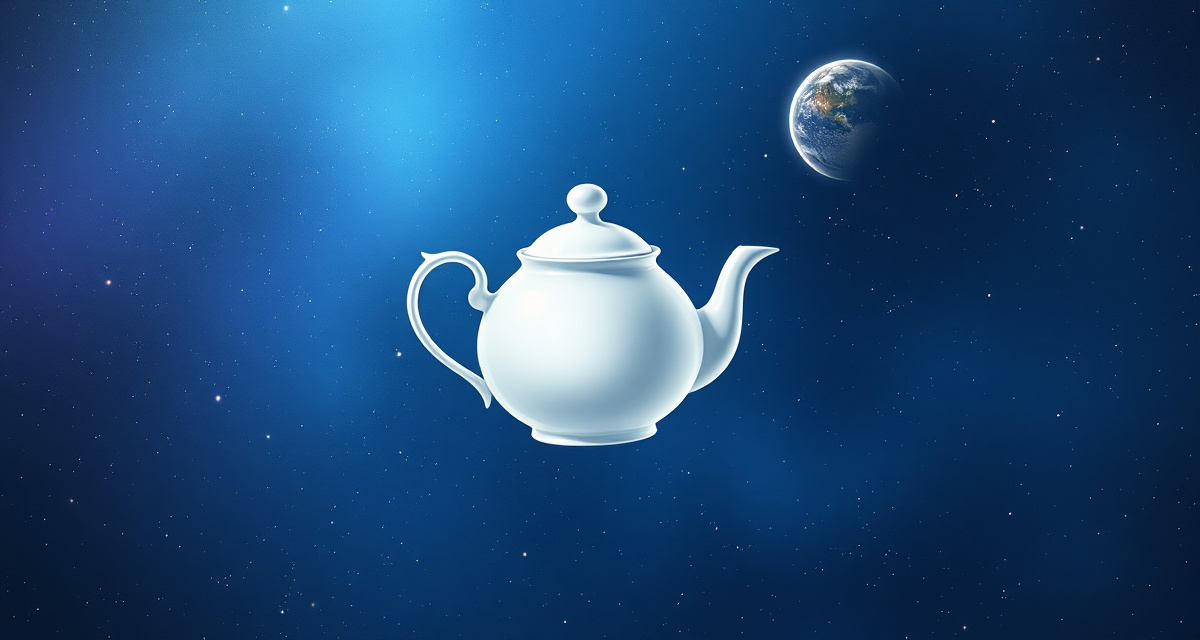
Russell asked his readers to imagine that he claimed there was a china teapot orbiting the sun in elliptical orbit somewhere between Earth and Mars. Furthermore, suppose the teapot was too small to be detected by even the most powerful telescopes. If he insisted that no one could disprove his claim, he wrote, no reasonable person should therefore conclude that the teapot exists. The burden of proof, he argued, rests on the person who makes the claim — not on the rest of us to demonstrate it false.
The teapot has been quoted, misquoted, defended, and dismissed for seventy years. Most of the discussion misses what Russell was actually arguing.
What Russell Said
Here is the original passage in full:
If I were to suggest that between the Earth and Mars there is a china teapot revolving about the sun in an elliptical orbit, nobody would be able to disprove my assertion provided I were careful to add that the teapot is too small to be revealed even by our most powerful telescopes. But if I were to go on to say that, since my assertion cannot be disproved, it is intolerable presumption on the part of human reason to doubt it, I should rightly be thought to be talking nonsense.
Two ideas are doing the work. First, the impossibility of disproof is not evidence for a claim. Many fanciful assertions are unfalsifiable in practice. That alone gives us no reason to take any of them seriously. Second, the burden of proof in any debate rests on the side making a positive claim about reality — not on the side that withholds belief in it.
Russell was not arguing that God is as silly as a teapot. He was making a narrower epistemological point about how rational discourse has to be structured.
What the Argument Establishes
Russell's teapot is best understood as a defense of a single, fairly modest principle: the absence of evidence against an unfalsifiable claim does not constitute evidence for it. This is uncontroversial in most contexts. No physicist would accept the claim "an undetectable particle exists" simply because no one has ruled it out. No historian would accept the claim "Caesar had a previously unknown brother" because the absence of records cannot disprove it.
The teapot transports this everyday reasoning standard into religious discourse and asks why the same standard should not apply.
What the Argument Does Not Establish
The teapot is often deployed as if it had settled the question of God's existence. It does no such thing, and Russell did not say it did. There are several limits worth taking seriously.
First, the analogy works only against the worst possible argument for God's existence — the argument from "you can't disprove it, so it must be true." Almost no serious theologian has ever argued this. Aquinas's Five Ways, Anselm's ontological argument, Plantinga's modal arguments, the moral arguments of figures like C.S. Lewis — none of these rely on the impossibility of disproof. They offer positive considerations, of varying strength, in favor of theism. The teapot is not in dialogue with any of them.
Second, the teapot's force depends on the prior probability of the claim. We assign china teapots a near-zero prior probability of being in space because we know how teapots come into existence (factories on Earth) and how things end up in solar orbits (gravity, momentum, large-scale astrophysical events). The two have no plausible connecting story. By contrast, the prior probability of God's existence is precisely the question under dispute. Critics of the analogy point out that assuming a near-zero prior is to assume the very thing the argument was supposed to demonstrate.
Third, the teapot deals only with empirical existence claims of an observable but undetected sort. Religious traditions characteristically claim God is not an item within the universe to be located by improved telescopes but the ground of the universe itself — a being whose existence, if real, would not be discoverable by the same methods that locate planets. Whether that traditional theistic claim is coherent is a separate philosophical question, but the teapot does not address it.
The teapot is a powerful argument against bad theistic arguments. It is not, by itself, an argument against God.
What It Got Right
Despite these limits, Russell's analogy succeeds at what it actually set out to do. It clarifies a confusion that does occasionally surface in popular religious discourse: the suggestion that any claim someone takes seriously deserves intellectual respect simply because it cannot be ruled out.
Karl Popper, working in the same intellectual generation, made a related point about scientific theories: a theory that excludes nothing predicts nothing, and a theory that predicts nothing tells us nothing about the world. Russell's teapot is the same insight applied to metaphysics. A claim that floats free of any possible disconfirmation is a claim that has bought its safety by paying with its content.
This is a discipline religious thinkers can welcome rather than resent. The strongest theological traditions — Augustinian, Thomist, Reformed — have always held that Christian truth is a truth about reality, capable of being affirmed or denied, capable of being asked after with one's whole intellect. They have not, characteristically, hidden behind unfalsifiability.
What It Should Make Us Ask
Russell's teapot, taken seriously, leaves us with two useful questions, regardless of where you start. What positive evidence — historical, philosophical, experiential — would count for your view? And what evidence would count against it? If you cannot answer the second, the first is not really evidence either. It is just confirmation.
The teapot does not decide the question. It decides what counts as honest argument about it.