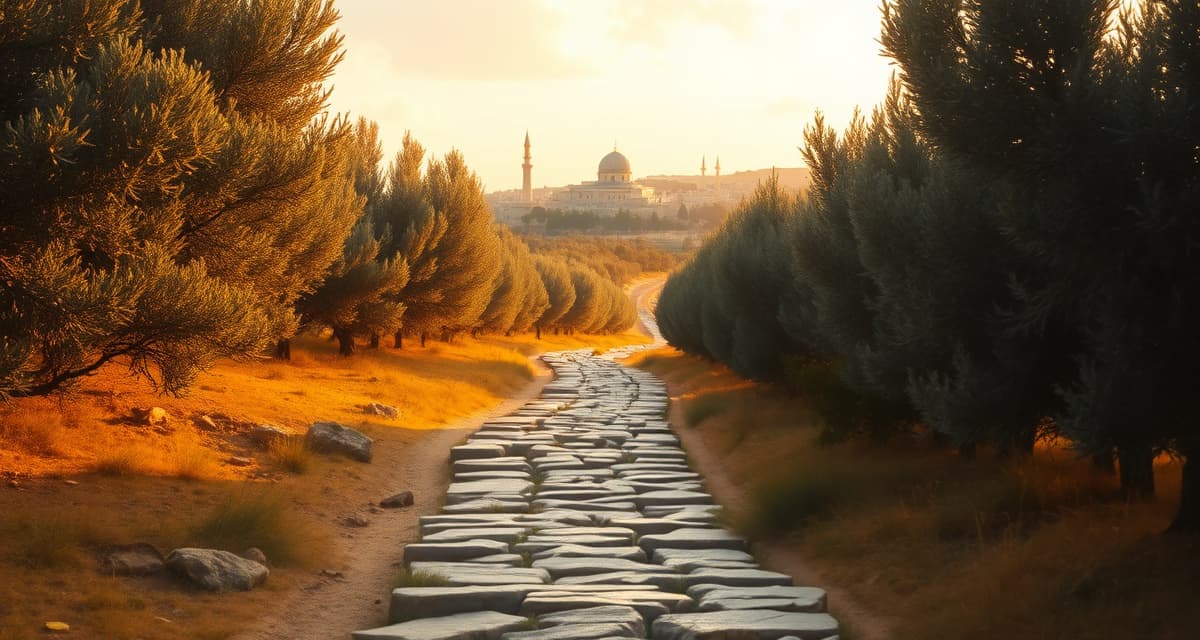
Tucked into the middle of the Psalter is a small collection of fifteen short poems. Psalms 120 through 134 each carry the same superscription in our Bibles — "A Song of Ascents." They are some of the briefest psalms in the entire collection, and some of the most loved. Together they form a pocket-sized hymnal that pilgrims sang as they walked toward Jerusalem for the great festivals of Israel.
To read them well, it helps to imagine the walking.
Who Sang Them, and Why
Three times a year — for Passover, Pentecost, and the Feast of Tabernacles — Jewish families across Israel and the diaspora made their way to Jerusalem to worship at the Temple (Deuteronomy 16:16). For most, this meant days of travel on foot. The road climbed. Jerusalem sits roughly 2,500 feet above sea level, and pilgrims literally ascended to reach it. The trip was not a vacation. It was a discipline of the body, performed in community, woven into the rhythm of the year.
The Songs of Ascents — also called the Pilgrim Psalms — are widely understood to be the soundtrack of that journey. Some scholars suggest the title also references the fifteen steps of the Temple, on which the Levites sang during certain festivals. Either way, the poems function as travel music for people on their way to a holy place.
What They're Like
The first thing to notice about these psalms is how short they are. Most are between five and nine verses. Many are only six or seven lines long. They are walking-pace prayers — easy to memorize, easy to sing in groups, easy to repeat when the road is long.
The second thing is how honest they are. The collection opens with Psalm 120, a complaint against deceitful neighbors and the misery of "dwelling in Meshech." The pilgrim's first words are not joyful praise but the lament of a person tired of where life has them: "Too long have I had my dwelling among those who hate peace" (Psalm 120:6). The journey to God begins with telling the truth about where you are.
By the end, in Psalm 134, the singers have arrived. They are standing in the courts of the house of the Lord at night, blessing God with raised hands. The arc moves from exile to worship, from longing to presence.
A Theology of the Road
What the Songs of Ascents teach, more than anything, is that the life of faith has a shape. It is a pilgrimage. The Christian writer Eugene Peterson borrowed a phrase from Friedrich Nietzsche to describe it — "a long obedience in the same direction" — and used these psalms as the framework of a book by that title. He saw in them a picture of discipleship: not a single spiritual experience, but a sustained walk toward the place where God dwells.
Several themes recur:
Looking up. Psalm 121 begins with one of the most quoted lines in the Old Testament: "I lift up my eyes to the hills. From where does my help come? My help comes from the Lord, who made heaven and earth." The hills could be Jerusalem in the distance — or the hills hiding bandits along the way. Either way, the answer is the same: God watches.
Trust under pressure. Psalm 124 imagines what would have happened "if it had not been the Lord who was on our side." Psalm 130 cries from "the depths." Psalm 131 stills the soul "like a weaned child with its mother." These are the prayers of people whose faith is being formed in real conditions, not abstract ones.
Communal joy. Psalm 122 begins, "I was glad when they said to me, 'Let us go to the house of the Lord!'" Psalm 133 marvels at the goodness of brothers dwelling in unity. The pilgrimage is not solitary. The journey itself is part of the worship.
Lessons for Anyone Walking
Most modern readers will never make a literal pilgrimage to Jerusalem. But the Songs of Ascents still describe something universal: that growth in God is a journey, not an event. It is paced. It involves leaving familiar dissatisfactions, climbing into difficulty, leaning on others, and arriving — eventually, often slowly — somewhere you could not have reached by sitting still.
A few practical observations the pilgrims modeled:
- Start where you actually are. Psalm 120 does not pretend things are fine. The road begins with honest lament.
- Keep the destination in view. "Pray for the peace of Jerusalem" (Psalm 122:6) is what you say when you can already see, in your imagination, the city you are walking toward.
- Sing on the way, not just on arrival. The psalms are road music. Worship is not reserved for the temple.
- Remember whose city it is. The pilgrim is not climbing toward an achievement; he is climbing toward a presence.
Why They Endure
The Songs of Ascents have outlived the road, the temple, and the festivals they were written for. They survived because they describe a pattern of life that has not changed: human beings, weighed down by the world, lifting their eyes, taking the next step, keeping company with each other, and moving — slowly, faithfully — toward God.
"Behold, bless the Lord, all you servants of the Lord, who stand by night in the house of the Lord! Lift up your hands to the holy place and bless the Lord!" (Psalm 134:1-2).
Fifteen short poems. One long road. The Pilgrim Psalms are a quiet invitation to walk it.