In 2007, scientists sent a batch of tiny animals into low Earth orbit, exposed them to the vacuum and radiation of space for ten days, and brought them home. Most of them survived. Some even laid viable eggs afterward.
The animals were tardigrades — also called water bears or moss piglets — and their survival was not a fluke. It was a demonstration of the most extreme resilience known in the animal kingdom.
What Tardigrades Are
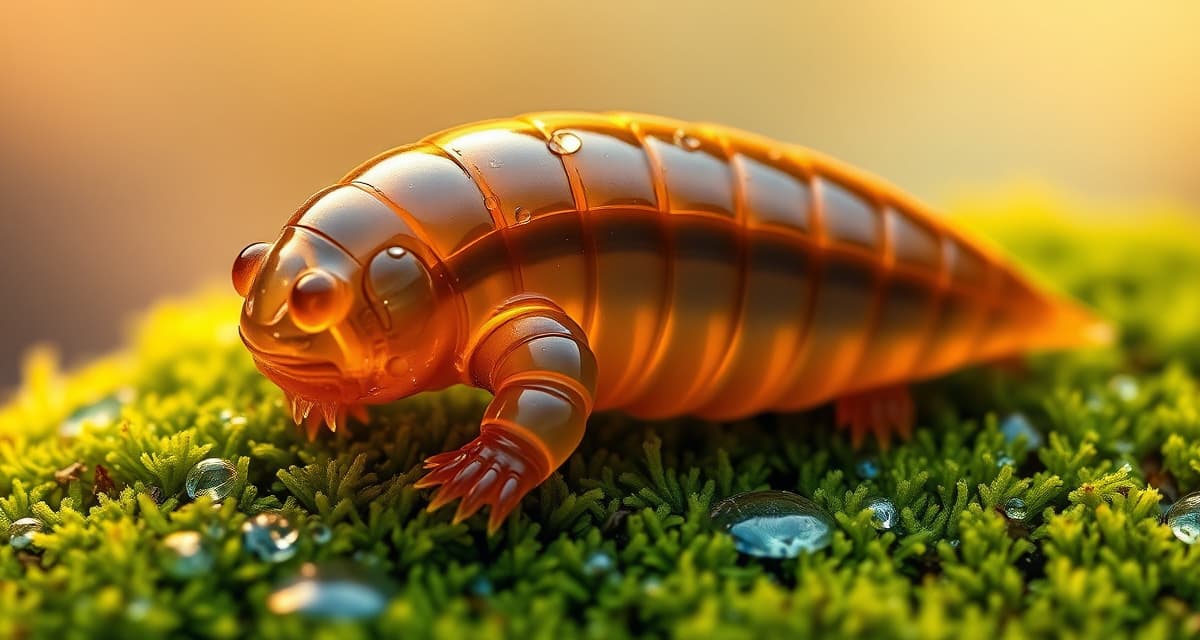
Tardigrades are microscopic animals, typically between 0.1 and 1.5 millimeters long. They have eight legs, a tubular mouth, and a plump, segmented body that gives them their charming common names. There are over 1,300 known species, found on every continent including Antarctica, in environments ranging from deep ocean trenches to Himalayan peaks, from hot springs to the Antarctic ice sheet.
They are genuine animals — not bacteria, not extremophile archaea, but multicellular organisms with nervous systems, muscles, and digestive tracts. They belong to their own phylum, Tardigrada, which is related to arthropods (insects, spiders, crustaceans). Most species feed on plant cells, algae, or small invertebrates by piercing them with their stylet — a needlelike mouthpart — and sucking out the contents.
Under normal conditions, tardigrades are unremarkable. They live in thin films of water on mosses and lichens, and their typical lifespan is a few months to a couple of years. What makes them extraordinary is what happens when conditions become hostile.
Cryptobiosis: Life on Pause
When a tardigrade's environment dries out, freezes, or becomes otherwise uninhabitable, it does something no other animal can match: it enters a state called cryptobiosis — literally, "hidden life."
In the best-studied form, called anhydrobiosis, the tardigrade loses nearly all its body water — dropping from roughly 85% water content to as low as 3%. Its metabolism slows to undetectable levels. It retracts its legs, curls into a compact ball called a tun, and essentially stops being alive in any conventional sense. No measurable metabolism. No respiration. No detectable biological activity.
And yet, when water returns — sometimes decades later — the tardigrade rehydrates and resumes normal life.
Research by Takekazu Kunieda and colleagues at the University of Tokyo, published in Nature Communications in 2016, identified one of the molecular mechanisms behind this ability: a family of proteins unique to tardigrades called tardigrade-specific intrinsically disordered proteins (TDPs). These proteins form a glass-like matrix when the animal dries out, protecting cellular structures from the damage that dehydration would normally cause. When the team inserted the genes for these proteins into human cell cultures, the cells showed improved stress tolerance — a remarkable demonstration that the tardigrade's trick has a specific molecular basis.
The Limits of Indestructibility
The popular image of tardigrades as indestructible is somewhat oversimplified, but their tolerances are genuinely staggering.
Temperature. Tardigrades in the tun state have survived temperatures as low as -272°C (just above absolute zero) and as high as 151°C, though survival at these extremes is brief. In active form, they are much more vulnerable.
Pressure. They have survived pressures of up to 6,000 atmospheres — roughly six times the pressure at the bottom of the Mariana Trench.
Radiation. Tardigrades can tolerate radiation doses hundreds of times higher than the lethal dose for humans. Research by Takuma Hashimoto and colleagues (2016) identified a protein called Dsup (damage suppressor) that binds to DNA and protects it from radiation-induced damage. When Dsup was expressed in human cells, radiation damage to DNA was reduced by approximately 40%.
Vacuum. The 2007 FOTON-M3 experiment, led by K. Ingemar Jönsson and colleagues at Kristianstad University in Sweden, demonstrated that tardigrades could survive ten days of exposure to the vacuum and solar UV radiation of space.
Time. In 2021, Japanese researchers reported reviving tardigrades from Antarctic moss samples that had been frozen for over 30 years. There are disputed claims of revival after much longer periods, but decades-long survival is well-documented.
What Tardigrades Teach Us
Tardigrades are scientifically significant beyond their novelty because they challenge assumptions about what life requires.
The boundary of life and non-life. In the tun state, a tardigrade meets almost none of the standard criteria for being alive. It does not metabolize, grow, respond to stimuli, or reproduce. Yet it is not dead — it retains the capacity to resume all those functions. This forces a question: is "alive" a binary state, or a spectrum? Tardigrades suggest it may be the latter.
The toolkit of resilience. The molecular mechanisms tardigrades use — TDPs, Dsup, trehalose sugar accumulation, efficient DNA repair — are of intense interest to applied science. Understanding how tardigrades protect their cells could lead to advances in preserving biological materials without refrigeration, protecting crops from drought, or shielding human cells from radiation during space travel.
Astrobiology. Tardigrades are frequently cited in discussions of panspermia — the hypothesis that life might travel between planets or even star systems aboard meteorites. Their demonstrated survival in space conditions means that, in principle, a tardigrade tun ejected from one planet by an asteroid impact could survive transit through space and potentially arrive on another world. Whether this has ever actually happened is unknown, but the fact that it is biologically possible is remarkable.
A Reminder of What We Don't Know
There are over 1,300 described tardigrade species, but estimates suggest many more remain undiscovered. We understand some of their molecular tricks, but the full picture of how they achieve their extraordinary resilience is still incomplete. They were first described in 1773 by German zoologist Johann August Ephraim Goeze, who gave them the name "little water bear," and they have been surprising scientists ever since.
In a world that tends to associate toughness with size and power, tardigrades offer a different lesson: the most resilient animal on Earth is invisible to the naked eye, lives in the water film on a piece of moss, and survives the unsurvivable not through strength but through the elegant chemistry of knowing when to stop.