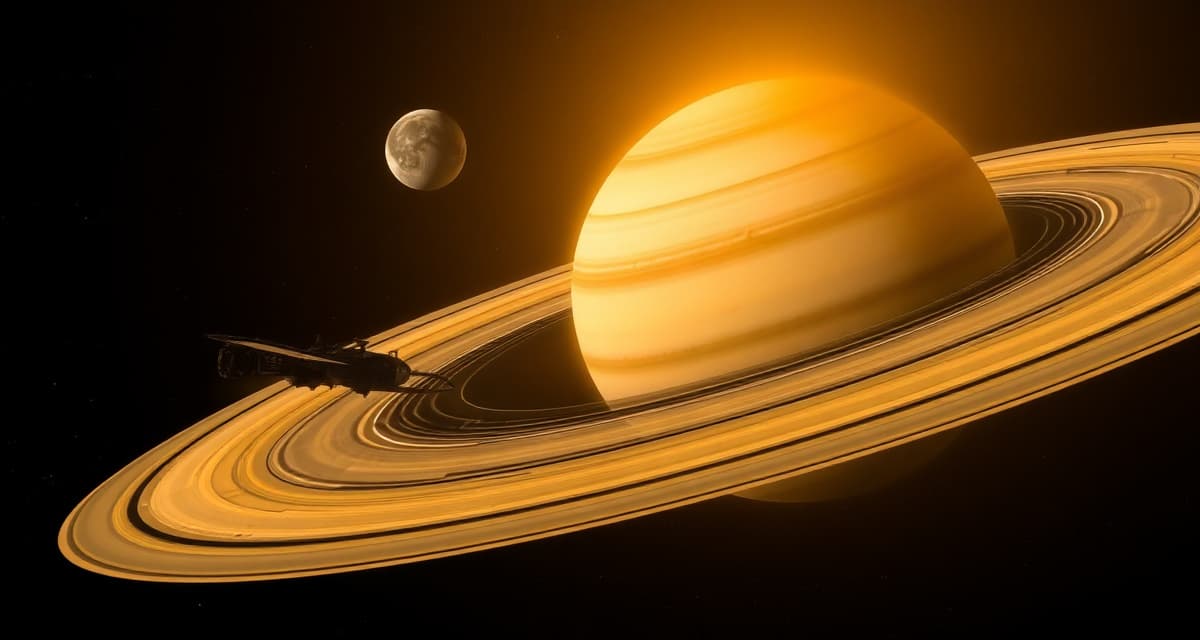
On September 15, 2017, the Cassini spacecraft plunged into Saturn's atmosphere at over 75,000 miles per hour and burned up. It had been orbiting Saturn for thirteen years, and its deliberate destruction was designed to protect the very moons it had spent over a decade studying — moons that, against all expectations, turned out to be some of the most promising places to search for life beyond Earth.
The Cassini-Huygens mission is one of the great achievements of space exploration. What it found at Saturn rewrote our understanding of where life might exist in the solar system.
The Mission
Cassini-Huygens was a joint project of NASA, the European Space Agency (ESA), and the Italian Space Agency (ASI). Launched on October 15, 1997, it took nearly seven years to reach Saturn, arriving in orbit on July 1, 2004. The spacecraft consisted of two main elements: the Cassini orbiter and the Huygens probe, designed to land on Saturn's largest moon, Titan.
The mission was originally planned for four years. It was so productive that NASA extended it twice — first as the "Equinox Mission" (2008–2010), then as the "Solstice Mission" (2010–2017). By the time it ended, Cassini had completed 293 orbits of Saturn, made 127 close flybys of Titan, and discovered features of the Saturn system that no one had predicted.
Titan: A World with Weather
On January 14, 2005, the Huygens probe detached from Cassini and descended through Titan's thick atmosphere — the only dense atmosphere on any moon in the solar system. It transmitted data for about 72 minutes after landing, sending back the first images from the surface of a body in the outer solar system.
What Huygens revealed was extraordinary. Titan has a hydrological cycle — but instead of water, it uses methane and ethane. Cassini's radar instruments later mapped vast lakes and seas of liquid hydrocarbons near Titan's north pole. Kraken Mare, the largest, is estimated to be roughly the size of the Caspian Sea.
Titan has rain, rivers, deltas, and shorelines — all made of liquid methane. Its surface temperature is about -179°C (-290°F), far too cold for liquid water on the surface. But beneath its icy crust, gravitational measurements by Cassini strongly suggest a subsurface ocean of liquid water, possibly mixed with ammonia.
This makes Titan a unique world: it has both liquid on its surface (methane) and liquid water underground. Whether either of these environments could support any form of life remains an open question — one that future missions will attempt to answer. NASA's Dragonfly mission, planned for launch in 2028, will send a rotorcraft to Titan's surface to investigate its chemistry directly.
Enceladus: The Surprise
The mission's most consequential discovery came from a moon that wasn't even a primary target. Enceladus, a small ice-covered moon only about 500 kilometers in diameter, was initially expected to be geologically dead — too small to retain enough internal heat for activity.
In 2005, Cassini's instruments detected something astonishing: plumes of water vapor and ice particles erupting from fractures near Enceladus's south pole. These "tiger stripe" fractures, roughly 130 kilometers long, were jetting material into space at velocities exceeding 1,300 kilometers per hour.
Subsequent flybys revealed that the plumes contained not just water ice but also sodium salts, silica nanoparticles, molecular hydrogen, and simple organic molecules. The sodium salts indicated that the water had been in contact with rock — a sign of hydrothermal activity. The silica nanoparticles suggested water temperatures of at least 90°C (194°F) at the ocean floor, consistent with hydrothermal vents similar to those found on Earth's ocean floors.
In 2014, Cassini's gravity measurements confirmed that Enceladus harbors a global subsurface ocean beneath its icy shell — not just a regional sea near the south pole, as initially suspected, but a body of liquid water surrounding the entire moon.
A small, ice-covered moon that should have been geologically inert turned out to have a global ocean, hydrothermal activity, and organic chemistry — the three key ingredients astrobiologists look for when assessing habitability.
Why Enceladus Matters for Life
On Earth, hydrothermal vents on the ocean floor support thriving ecosystems that derive energy not from sunlight but from chemical reactions between hot water and rock — a process called chemosynthesis. These vent communities include bacteria, archaea, tube worms, shrimp, and other organisms that live entirely without photosynthesis.
The discovery of hydrothermal activity on Enceladus means that the same basic energy source that supports life in Earth's deepest oceans is available on a moon of Saturn. The key ingredients are all present:
- Liquid water — confirmed by multiple independent measurements
- Chemical energy — molecular hydrogen from rock-water interactions provides fuel for methanogenic microbes
- Organic molecules — detected in the plumes by Cassini's mass spectrometer
- Mineral nutrients — silica, sodium, and other elements detected in plume material
This doesn't prove life exists on Enceladus. But it means the environment is not hostile to it in any obvious way. As astrobiologist Chris McKay has noted, Enceladus may be the most accessible place in the solar system to test for extraterrestrial life, because its ocean is literally spraying samples into space. A future mission could fly through the plumes, collect material, and analyze it without ever having to drill through ice.
Saturn's Rings and the Grand Finale
Beyond the moons, Cassini transformed our understanding of Saturn itself. The spacecraft revealed the rings in unprecedented detail — dynamic structures shaped by tiny "shepherd moons," density waves, and gravitational resonances. Cassini discovered that the rings are being pulled into Saturn by gravity, losing material at a rate that suggests they may disappear within 100 million years — cosmologically soon. The rings, it seems, are not a permanent feature but a temporary one, and we happen to live during the window when they exist.
During its final months, the "Grand Finale" phase, Cassini dove repeatedly between Saturn and its innermost ring — a gap no spacecraft had ever entered. These final orbits provided the most precise measurements of Saturn's gravitational field, magnetic field, and internal structure ever obtained. They revealed that Saturn's core is not a solid mass but a "fuzzy" region of heavy elements diffused over a large volume — a finding that challenged existing models of giant planet formation.
The Deliberate End
Cassini was destroyed intentionally. With its fuel running low, mission planners faced a choice: let the spacecraft drift uncontrolled (risking an eventual crash into Enceladus or Titan and potential contamination with Earth microbes) or deliberately steer it into Saturn's atmosphere. They chose destruction to protect the moons — a decision guided by planetary protection protocols designed to prevent biological contamination of potentially habitable worlds.
The spacecraft transmitted data until the very end. On September 15, 2017, it entered Saturn's atmosphere, tumbled, lost contact with Earth, and disintegrated. Its final signal took 83 minutes to reach the Deep Space Network antennas in Canberra, Australia.
What Comes Next
Cassini's discoveries have driven the next generation of missions. NASA's Dragonfly will explore Titan's surface chemistry. Multiple mission concepts for Enceladus — including the proposed Enceladus Orbilander — would search directly for biosignatures in the plume material.
The Cassini mission demonstrated something profound: you don't have to leave the solar system to find worlds that challenge your assumptions about where life might exist. The answer to whether we are alone may not require interstellar travel. It may require nothing more than a closer look at the moons of our own cosmic neighborhood.