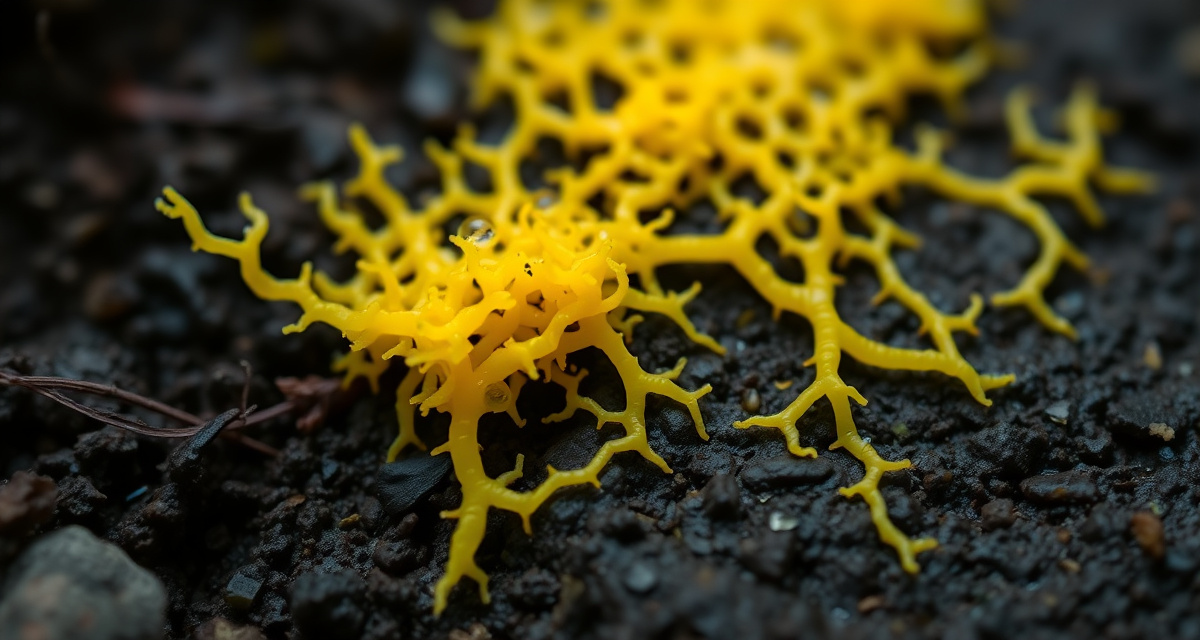
In 2000, a Japanese researcher named Toshiyuki Nakagaki dropped a piece of yellow slime in the middle of a small maze. He placed two food sources — oat flakes — at separate exits. The slime spread out in every direction, exploring the maze. After a few hours, it had retracted from every dead end and connected the two food sources by the shortest possible path.
The slime in question, Physarum polycephalum, has no brain. It has no neurons. It is not even an animal. It is a single-celled organism that can grow to cover several square feet of forest floor. And it had just solved a maze.
Nakagaki published the result in Nature under one of the more memorable titles in recent science: Maze-solving by an amoeboid organism. It was the start of a small revolution in how biologists think about cognition, problem-solving, and what kinds of systems are capable of intelligent behavior.
What Slime Molds Actually Are
The name slime mold covers a few different organisms. The one most studied — Physarum polycephalum — is what biologists call a plasmodial slime mold. In its active feeding stage it is a single, enormous cell containing thousands or even millions of nuclei, sliding across the ground in a network of pulsing yellow tubes.
Slime molds are not fungi. They are not animals. They belong to a group of organisms called amoebozoans, only distantly related to the rest of the eukaryotic tree.
In their lifetime they cycle through dramatic forms: tiny independent amoebae that can swim, then a fused plasmodium that hunts as one giant cell, then — when conditions get bad — a fruiting body that releases spores. They are, in short, weirder than most science classes have time for.
How a Brainless Organism Solves a Maze
The maze trick was not magic. It was a beautifully simple decentralized algorithm.
In its plasmodial form, Physarum is a network of tubes through which protoplasm — its internal fluid — flows. The network is dynamic: tubes that carry more flow get reinforced, becoming thicker and more efficient; tubes that carry less flow gradually wither.
When Physarum covers a maze, every possible path is initially explored. But longer paths — the ones with dead ends or detours — develop weaker flow patterns. Shorter, more efficient paths develop stronger flow. Over hours, the network prunes itself into the optimal solution.
This kind of process is called adaptive flow optimization. It is, mathematically, very close to the algorithms engineers use to design transportation networks. Which is exactly what researchers have done with it.
When Physarum Designed the Tokyo Rail System
In 2010, Atsushi Tero and a team of researchers placed oat flakes on a map of the Greater Tokyo region, with each flake corresponding to a major city around Tokyo, and dropped Physarum on the central node. They added obstacles — bright light — over areas corresponding to mountains and water that real engineers would also have avoided.
After 26 hours, they had a network. When they compared it to the actual Tokyo rail system, the two were strikingly similar — comparable in efficiency, robustness, and total length. The slime mold, with no plan, no engineer, and no memory, had reproduced the broad architecture of one of the world's most refined transit networks.
A bag of cytoplasm with no brain solved a transportation engineering problem about as well as the Japanese rail authority did.
The point of the experiment was not that slime molds should design real subway systems. The point was that the kind of decentralized flow optimization the slime uses is genuinely powerful — powerful enough to give engineers ideas about distributed routing, network resilience, and self-organizing infrastructure.
What Looks Like Memory
In a 2016 study, Audrey Dussutour and colleagues showed that Physarum could learn to ignore harmless irritants. When the slime had to cross a strip of caffeine-laced agar to reach food, it initially avoided the strip. After repeated exposures, it learned to cross without hesitation.
When two slime molds were fused — a process Physarum can undergo physically — the merged organism behaved as if it had inherited the learned indifference, even if only one of the original parents had been trained.
This is not learning in any human sense. There is no neural representation, no encoding of an explicit memory. But there is a kind of stored adaptation in the network's chemical and structural state, which can transfer through fusion. It is genuinely puzzling to anyone who assumed memory required a nervous system.
What This Means for How We Think About Intelligence
Slime molds force a hard question. We typically link intelligence to brains. Physarum solves shortest-path problems, navigates complex environments, allocates effort, and even shows something like associative learning. None of this happens in a brain because there is no brain.
The scientific lesson is not that slime molds are smart in the way humans or even insects are smart. The lesson is that cognition-like behavior can emerge from much simpler substrates than biology long assumed. Distributed feedback, chemical signaling, and physical flow can produce results that look, from the outside, intelligent.
This has practical consequences. Computer scientists studying decentralized algorithms now look at Physarum as a model. Ecologists use slime mold dynamics as a metaphor for fungal networks in soil. Roboticists have built swarm-control systems explicitly inspired by it.
Where the Science Is Going
Recent work has continued to surprise. Studies have shown Physarum can:
- Anticipate periodic disturbances, slowing its movement before a recurring stimulus
- Make optimal choices in classic decision-theory tasks involving trade-offs between food quality and quantity
- Solve traveling-salesman-style routing problems for moderately sized inputs
- Coordinate activity across its body with no central controller
Researchers are careful with their language. Words like think, decide, and learn sit awkwardly on a single slimy cell. But removing those words entirely understates what the organism actually does. The honest description sits somewhere in the middle: a brainless system performing computations that look, behaviorally, a great deal like the ones brains perform.
For most of the history of biology, intelligence was treated as something that lived in nervous tissue. Slime molds quietly question that assumption. They are not what most people picture when they imagine a clever organism. They are also, on the evidence, more capable than most of us would have guessed.