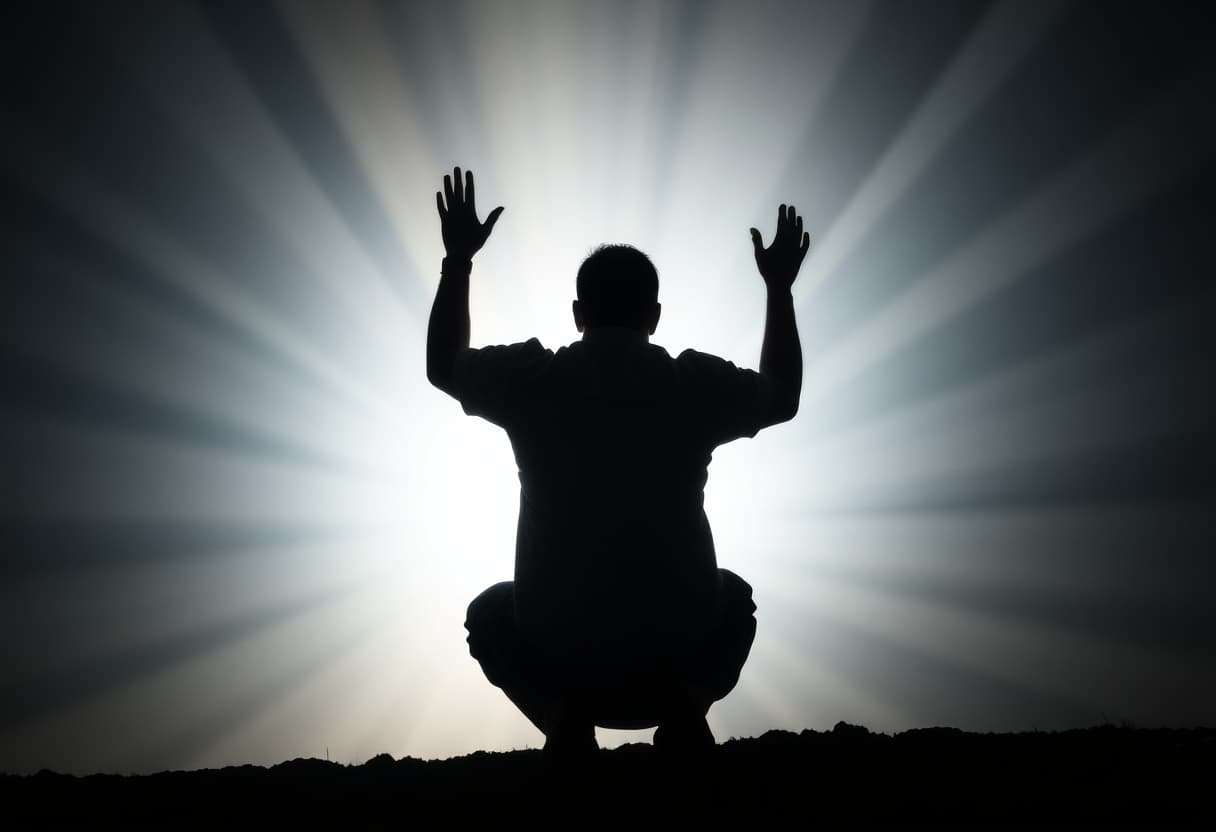
When we speak of God's holiness, we usually mean something like moral perfection — the idea that God is without sin, utterly pure. This is true, but it captures only a fraction of what the biblical authors meant. The Hebrew word qadosh, and its Greek counterpart hagios, point to something more fundamental: separateness, otherness, a category of being that stands wholly apart from the created order. Understanding this distinction changes how we read Scripture — and how we approach God.
The Root Meaning: Set Apart
In Hebrew thought, holiness was not primarily an ethical category but an ontological one. To be holy was to belong to a different order of existence. Objects could be holy: the ark of the covenant, the Sabbath, the temple vessels. None of these had moral qualities. Their holiness derived entirely from their being consecrated — set apart for God's use, drawn out of the ordinary world and into a different sphere.
This is why Leviticus is so relentless about distinctions: clean and unclean, sacred and common, priest and layperson. These weren't arbitrary rules. They were a pedagogical structure, teaching Israel through daily life that the God at the center of their existence was not like anything else in the universe.
When Isaiah stands before the divine throne and hears the seraphim cry "Holy, holy, holy is the LORD of hosts" (Isaiah 6:3), the triple repetition — rare in Hebrew — signals the superlative. Not merely holy, but holy beyond what any single utterance can contain.
Rudolf Otto and the Mysterium Tremendum
The twentieth-century theologian Rudolf Otto tried to recover this primal sense of divine otherness in his landmark work The Idea of the Holy (1917). He coined the phrase mysterium tremendum et fascinans — the mystery that is both terrifying and fascinating.
Otto argued that encounters with genuine holiness produce a double response: dread before something that utterly surpasses us, and yet an irresistible attraction toward it. This is exactly what we see in biblical theophanies. Moses hides his face at the burning bush. Isaiah cries out, "Woe is me! For I am lost; for I am a man of unclean lips." Peter falls at Jesus's knees after the miraculous catch of fish and says, "Depart from me, for I am a sinful man" (Luke 5:8).
The creature's awareness of itself as creature — finite, dependent, morally compromised — is awakened precisely by its encounter with the Creator's infinite holiness.
This isn't the holiness of a distant, cold deity. It's the holiness of a consuming fire that draws near.
Holiness and Moral Purity: How They Connect
So where does ethics enter? The connection is not coincidental. Because God is ontologically other, He is also the ground of all moral reality. His character is not measured against some external standard — He is the standard. When Scripture says "Be holy, for I am holy" (Leviticus 11:44, 1 Peter 1:16), it is calling Israel — and the church — into a participation in God's nature, not merely compliance with a rule list.
This is why sin in the Old Testament carries such weight. To sin is not only to break a rule; it is to profane what was meant to be holy, to drag the sacred into the common. The gravity of sin in Scripture is unintelligible without the backdrop of God's holiness — and the elaborate sacrificial system of the Torah makes no sense unless understood as a means of restoring the boundary between the holy and the defiled.
The Cross as the Meeting Point
Christian theology argues that the cross is precisely where God's holiness and humanity's defilement meet. The atonement has been explained in many ways — substitution, ransom, moral influence — but at its core it addresses the problem that a holy God cannot simply absorb unholiness without cost.
Paul's dense reasoning in Romans 3:25–26 makes this explicit: God "passed over former sins" in patience, not by ignoring them, but with the cross in view — so that He might be both "just and the justifier" of the one who has faith in Jesus. The holiness of God demanded satisfaction; the love of God provided it.
Living in Light of Holiness
For the ordinary believer, recovering a robust sense of divine holiness transforms the texture of worship, prayer, and daily life. It rescues prayer from the casual transactionalism that treats God as a cosmic service provider. It gives confession its weight back. It makes worship more than a mood-setting exercise at the start of a church service.
The mystics of the Christian tradition — Bernard of Clairvaux, John of the Cross, Julian of Norwich — wrote out of a palpable awareness of God's otherness. Their writings feel different from devotional self-help because they are oriented toward a God who is genuinely, startlingly other. That encounter with otherness is what they describe as transformative: not instruction from a distant deity, but encounter with a holy presence that reshapes the one who draws near.
To know God as holy is not to be kept at arm's length. It is, paradoxically, to be drawn into the most intimate possible relationship — one in which we are changed by what we cannot fully comprehend.
Sources ¹ Rudolf Otto — The Idea of the Holy (1917) ² John N. Oswalt — The Book of Isaiah, Chapters 1–39, NICOT (1986) ³ John Webster — Holiness (2003)