In the summer of 1977, NASA launched two spacecraft about two weeks apart from Cape Canaveral. They were modest by the standards of modern science budgets — a combined cost in 1970s dollars of roughly $865 million — and they were designed for a four-year primary mission to fly past Jupiter and Saturn. They were named Voyager 1 and Voyager 2.
Forty-eight years later, both are still operating. Both have left the solar system in a meaningful sense. Both are still sending back data from instruments that have been running continuously since the year of Star Wars and the Apple II. Voyager 1 is the most distant human-made object in existence — currently more than 15 billion miles from the Sun and growing further by about 38,000 miles every hour.
The Voyager probes are one of the most remarkable engineering achievements in history. They are also still doing science.
What They Were Built For
The original mission took advantage of a rare planetary alignment that occurs approximately every 175 years. When the outer planets line up correctly, a single spacecraft can use each planet's gravity to slingshot itself toward the next one — picking up speed at every encounter without needing to carry the fuel that would normally be required.
Voyager 2 launched first, on August 20, 1977. It flew past Jupiter, Saturn, Uranus, and Neptune, becoming the only spacecraft ever to visit the two outermost planets. The images it returned of Neptune's blue atmosphere and the geysers of its moon Triton remained the only close-up data on those bodies for more than three decades.
Voyager 1 launched sixteen days later on a faster trajectory that bypassed Uranus and Neptune for a closer look at Saturn's largest moon, Titan. Its imaging of Jupiter and Saturn — and especially of Jupiter's moon Io, where it captured the first known active volcanism beyond Earth — rewrote planetary science overnight.
By the late 1980s, the planetary phase of both missions was complete. NASA could have shut them down. Instead, the agency redefined the mission. With both probes still healthy and traveling outward, they could be repurposed to study the boundary between the solar system and interstellar space — a region no human instrument had ever directly sampled.
The Heliopause Crossing
The Sun continuously emits a stream of charged particles called the solar wind, which forms a vast bubble around the solar system known as the heliosphere. Beyond the heliosphere lies true interstellar space, dominated by particles and magnetic fields from other stars and ancient supernovae rather than from our own Sun.
Where the heliosphere ends and interstellar space begins is called the heliopause. Until Voyager, no instrument had ever measured it directly. Theoretical models predicted its location, but the actual physics of the transition — what the boundary looks like, how sharp it is, what particles dominate which side — was guesswork.
Voyager 1 crossed the heliopause on August 25, 2012, becoming the first human-made object to enter interstellar space. Voyager 2 crossed in November 2018, in a different direction, providing the first paired measurements of the boundary. The data confirmed some predictions, overturned others, and revealed that the heliopause is not a clean line but a turbulent region where solar and interstellar plasma slosh against each other.
Both probes are now sampling the actual interstellar medium — the medium that fills the galaxy between stars — for the first time in human history.
How Engineering From the 1970s Is Still Working
The probes are powered by radioisotope thermoelectric generators (RTGs) — devices that convert the heat from decaying plutonium-238 into electricity. Each RTG produced about 470 watts at launch. Forty-eight years of decay have reduced their output to roughly 240 watts each, and dropping. To stretch the remaining power, NASA engineers have spent the last decade systematically shutting down non-essential instruments and even heaters.
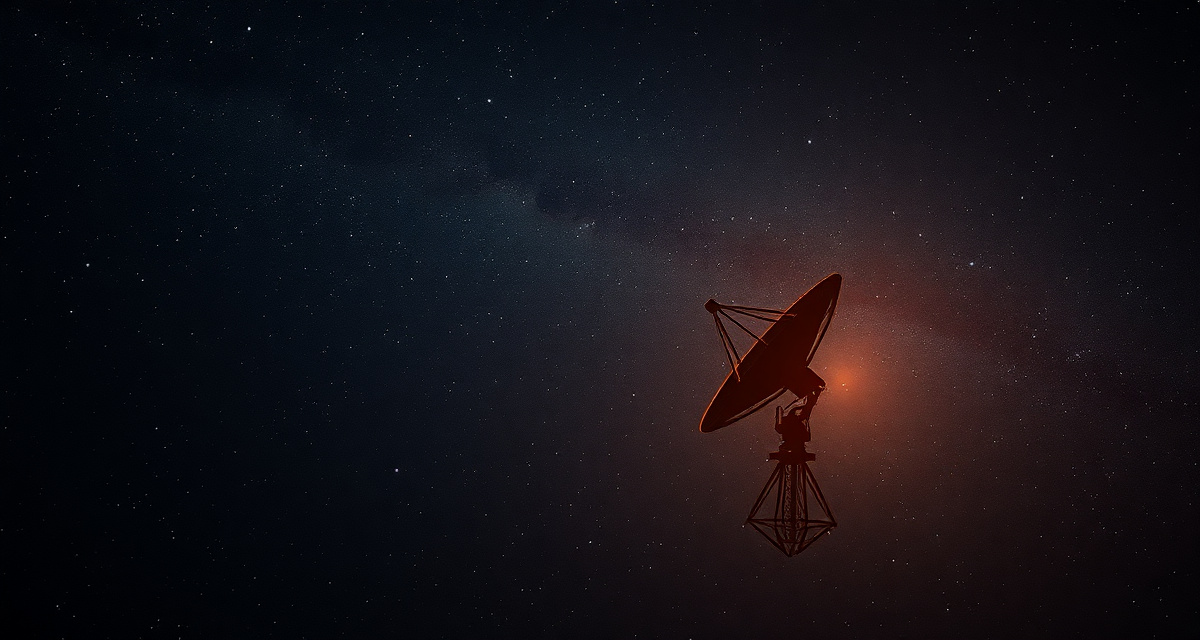
The communications system is similarly remarkable. Voyager 1's signal currently takes about 23 hours to reach Earth, traveling at the speed of light. By the time it arrives, the signal is so faint — measured in attowatts — that NASA's Deep Space Network has to combine the receiving power of multiple massive radio dishes to read it at all.
The onboard computers operate at about 8,000 instructions per second, processed through 70-kilobyte memory banks. By comparison, a modern smartphone is roughly four billion times more capable. Yet those 1970s computers, programmed in assembly and patched remotely from Earth, continue to manage the spacecraft and report back.
When something goes wrong, NASA engineers — many of them now in their seventies, the only people alive who still remember the original code — patch it remotely. In late 2023 and early 2024, Voyager 1 began returning garbled data because of a memory chip failure on one of its computers. After months of careful work, the team rerouted the affected code to other parts of the memory and restored normal operation. The fix had to traverse 30 billion miles of space and wait nearly a full day for confirmation.
The Golden Records
Each Voyager carries a 12-inch gold-plated copper phonograph record — the Voyager Golden Records — containing sounds and images selected to portray the diversity of life and culture on Earth. Greetings in 55 languages. The sound of a human heartbeat. Music from Bach, Beethoven, Chuck Berry, and Indian raga performers. Photographs of human anatomy, mathematical concepts, and Earth's landscapes.
The records were a project led by Carl Sagan and a team that included Ann Druyan, Frank Drake, and Linda Salzman Sagan. They are unlikely to ever be encountered by intelligent life. They are functionally a message in a bottle thrown into a galaxy that is mostly empty space. But they are also a kind of cultural artifact, encoding what late-twentieth-century humans wanted other minds to know about us if other minds ever existed.
The records will outlast every other artifact of human civilization. Encased in their aluminum jackets and traveling through a near-vacuum, they could conceivably remain readable for hundreds of millions of years.
What Comes Next
The Voyagers will keep operating until their power supply finally drops below the threshold needed to run any single instrument — currently estimated to occur around 2030. After that, they will fall silent, but they will not stop moving.
Voyager 1 is heading toward the constellation Ophiuchus. In about 40,000 years, it will pass within 1.6 light-years of a star called Gliese 445. Voyager 2 is heading toward the constellation Andromeda; in about 40,000 years it will come within 1.7 light-years of Ross 248. After that, both probes will continue indefinitely, drifting through interstellar space, almost certainly never to encounter another star at close range, almost certainly to outlast Earth itself.
The Voyagers represent something rare in human achievement: a project conceived by people who knew they would not live to see its full results, executed with patience and craft, and still bearing fruit nearly half a century later. They are reminders that careful engineering, modest budgets, and long horizons can sometimes accomplish more than the loudest and best-funded efforts of any given decade. And they are quietly, faithfully, still listening to a universe most of us will never see.